Punjab Sanjhi Sabzi Scheme: Free Vegetables Explained
Inflation and rising food prices have made it increasingly difficult for low-income households to afford fresh and nutritious food. To address this challenge at the community level, the provincial government has introduced the Punjab Sanjhi Sabzi Scheme, officially promoted under the slogan “Sasti Nahi Muft Sabzi, Sanjhi Sabzi.”
The slogan means “Not cheap but free vegetables, shared vegetables.” Instead of selling vegetables at subsidized prices, the initiative focuses on cultivating seasonal produce on unused government land and distributing it free of cost among deserving residents.
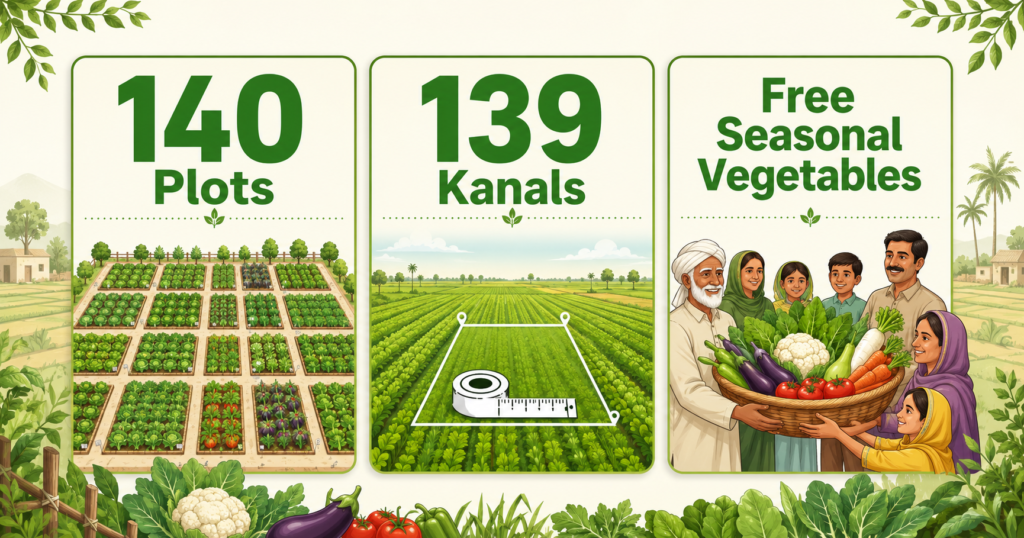
The project was initially implemented in Muzaffargarh, where seasonal vegetables are being cultivated on 140 plots covering approximately 139 kanals. Following the positive response, Punjab Chief Minister Maryam Nawaz Sharif directed deputy commissioners across the province to reproduce the model in their districts. The Nation reported the provincial expansion directive and Muzaffargarh project figures.
Although the program has attracted significant public interest, it is important to understand that it is currently a community cultivation and distribution initiative. No centralized online registration portal, application form, SMS service or fixed cash payment has been announced.
What Is the Punjab Sanjhi Sabzi Scheme?
The Punjab Sanjhi Sabzi Scheme is a community welfare and food-security initiative through which vegetables are grown on available public land. After harvesting, the produce is distributed among local families without charging them.
It is different from conventional government subsidy programs. Beneficiaries are not given cash, loans, cards or vouchers. Instead, they receive seasonal vegetables grown through government-supported and community-managed cultivation.
Families looking for financial welfare assistance can also read our CM Punjab Rahmat Card App download and registration guide to understand its application process and available support.
Unused areas around public buildings, offices and rural government properties may be identified for growing vegetables. The basic objective is to transform vacant public land into productive community gardens.
The initiative began as a local project in Muzaffargarh and was launched on the directions of Chief Minister Maryam Nawaz Sharif. Its early implementation demonstrated how government land, district administration and local participation could be combined to provide practical food assistance.
Punjab Sanjhi Sabzi Scheme at a Glance
| Feature | Available information |
|---|---|
| Program name | Sasti Nahi Muft Sabzi, Sanjhi Sabzi |
| Initial district | Muzaffargarh |
| Main benefit | Free seasonal vegetables |
| Initial cultivation area | Approximately 139 kanals |
| Number of plots | 140 |
| Distribution method | Local distribution according to need |
| Initial beneficiaries | Deserving residents and families |
| Program type | Community cultivation and food support |
| Cash assistance | Not included |
| Online registration | Not announced |
| Provincial expansion | Directed for districts across Punjab |
| Leading authority | Punjab government and district administrations |
Meaning of “Sasti Nahi Muft Sabzi, Sanjhi Sabzi”
The name communicates the most important feature of the initiative. “Sasti Nahi” means “not cheap,” while “Muft Sabzi” means “free vegetables.” “Sanjhi Sabzi” refers to vegetables grown and shared for the collective benefit of a community.
Therefore, the program is not merely another discounted vegetable market. Its purpose is to establish local gardens where seasonal produce can be grown and shared with households experiencing financial hardship.
The name also reflects the community-led philosophy behind the Punjab Sanjhi Sabzi Scheme. Public land provides the cultivation space, district authorities facilitate the project and residents may help grow and maintain the crops.
How Does the Scheme Work?
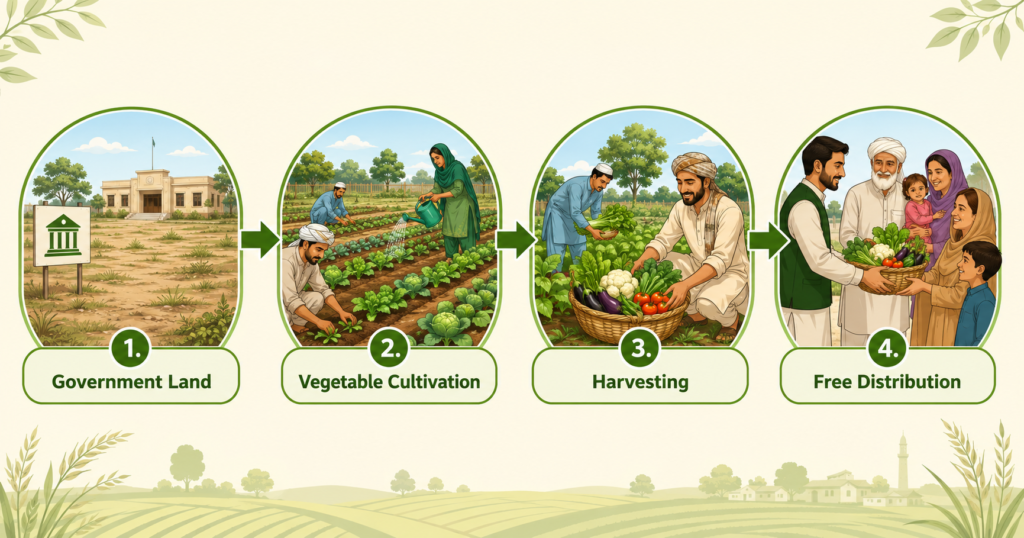
The working model of the program can be divided into five stages:
1. Identification of Available Government Land
District authorities identify small vacant plots and unused areas surrounding government properties. According to published reports, identified land may range from one marla to one kanal in individual locations.
Land around health, education, forest and local government properties may be considered. Areas near assistant commissioners’ offices and other public buildings can also be used where cultivation is practical.
2. Preparation of Community Gardens
Once suitable land has been identified, it is cleared and prepared for cultivation. Soil preparation, availability of water, seed selection and crop suitability are considered before planting begins.
3. Cultivation of Seasonal Vegetables
Vegetables suitable for the local climate and season are planted. The exact varieties can differ according to the district, weather, soil and availability of seeds.
The emphasis on seasonal produce helps reduce cultivation costs and improves the chances of obtaining a healthy local harvest.
4. Community Participation
A defining feature of the Punjab Sanjhi Sabzi Scheme is local participation. Residents may voluntarily help cultivate, maintain or harvest vegetables for vulnerable households.
The original model reportedly began in a Christian community village in Muzaffargarh. Residents subsequently started growing vegetables voluntarily to support other people in their area.
5. Free Distribution
After harvesting, the vegetables are distributed free of cost. Reports indicate that residents have started receiving produce according to their needs. However, detailed province-wide rules governing quantity, frequency and beneficiary verification have not yet been publicly standardized.
Who Can Receive Free Vegetables?
The initiative is primarily intended to support deserving families affected by inflation and rising food prices. Nevertheless, the government has not yet published a province-wide eligibility notification listing exact income limits, age requirements or documentation rules.
Depending on local implementation, priority may be given to:
- Low-income households
- Families experiencing food insecurity
- Widows and families without stable income
- Elderly residents with limited financial support
- Daily-wage workers
- Persons with disabilities
- Large families struggling with grocery expenses
- Other deserving residents identified locally
Families needing medical assistance for a child with a heart condition can also learn about the Children Heart Surgery Program and its free treatment services
These categories should be treated as likely local priorities rather than officially confirmed universal eligibility rules. Residents should obtain current information from their district administration.
How to Apply for the Punjab Sanjhi Sabzi Scheme
At present, no official online application process has been announced for the Punjab Sanjhi Sabzi Scheme. There is also no confirmed mobile application, SMS code, dedicated web portal or downloadable form.
People interested in the initiative can follow these steps:
- Contact the relevant deputy commissioner or assistant commissioner’s office.
- Ask whether a Sanjhi Sabzi garden has been established in the local area.
- Contact the union council or local government representative.
- Request information about the distribution point and schedule.
- Ask whether beneficiary verification or identification is required.
- Follow only announcements issued through official government channels.
Residents should not pay an agent or middleman. Participation and vegetable distribution under the announced model are free.
Documents That May Be Required
No standard list of documents has been officially announced. Local administrations may request basic information to confirm identity, residence or financial need. Possible documents could include:
- Original CNIC
- Copy of CNIC
- Punjab address or proof of residence
- Household information
- Disability certificate, where applicable
- Widowhood or income-related evidence, if requested locally
Applicants should not submit documents to unofficial websites, social media pages or private agents. Requirements may vary between districts as the program expands.
Muzaffargarh Pilot Project
Muzaffargarh is the starting point and working model for the provincial initiative. Vegetables are reportedly being cultivated across 140 plots with a total area of approximately 139 kanals.
Land surrounding properties belonging to the health, education, local government and forest departments is among the public space being utilized. The approach demonstrates that even relatively small vacant plots can contribute to a larger community food network.
Chief Minister Maryam Nawaz also recognized Muzaffargarh Deputy Commissioner Muhammad Usman Tahir Jappa for the welfare initiative, presenting him with a merit badge and a cash award, according to The Nation.
Expansion Across Punjab
After reviewing the Muzaffargarh model, the chief minister directed all deputy commissioners to introduce similar projects in their respective districts.
This direction gives the Punjab Sanjhi Sabzi Scheme the potential to expand from one district into a province-wide network of community gardens. Implementation may not begin at the same time in every district because suitable land, water, staff and cultivation arrangements must first be identified.
Residents should consequently wait for district-specific announcements regarding garden locations, harvest schedules and distribution procedures.
Major Benefits of the Initiative
Relief from Food Inflation
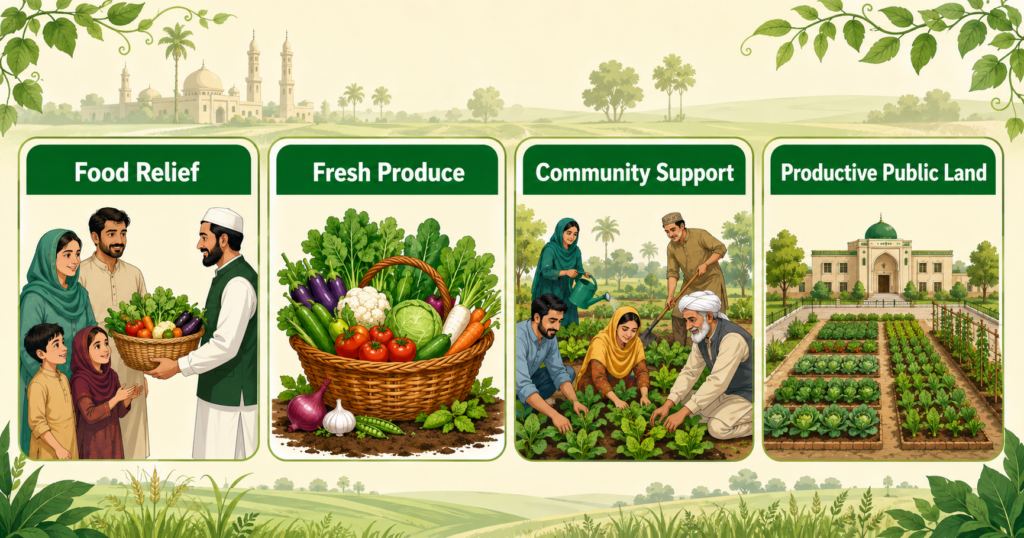
Free vegetables can reduce a family’s weekly grocery expenses. Although the benefit is provided in kind rather than cash, it can leave households with more money for flour, medicine, education and utility bills.
Households requiring support for roof repairs or home improvements may also explore the Apni Chhat Mehfooz Chhat Scheme 2026 online application guide
Better Access to Nutritious Food
Fresh vegetables are an important part of a balanced diet. Regular access can improve dietary variety for families that may otherwise reduce vegetable purchases because of high prices.
Productive Use of Vacant Land
The Punjab Sanjhi Sabzi Scheme turns unused government spaces into productive gardens. This can improve the appearance and usefulness of neglected plots while supporting community welfare.
Stronger Community Cooperation
Residents can participate in planting, watering, maintaining and harvesting crops. Shared responsibility can strengthen cooperation between communities and local administrations.
Improved Local Food Security
Locally cultivated produce reduces dependence on long supply chains. Community gardens may provide modest but valuable support when market prices rise or transportation is disrupted.
A Replicable Welfare Model
The project does not necessarily require large tracts of agricultural land. Several small plots can collectively produce vegetables, making the model suitable for replication in different districts.
Challenges the Program May Face
The long-term success of the Punjab Sanjhi Sabzi Scheme will depend on more than planting seeds. Gardens require reliable water, suitable soil, fencing, supervision and continuous maintenance.
Potential challenges include:
- Water shortages during hot weather
- Damage caused by animals or unauthorized harvesting
- Lack of clear and transparent distribution rules
- Unequal access among villages or neighbourhoods
- Limited quantities compared with local demand
- Crop loss caused by pests, disease or extreme weather
- Inadequate maintenance after the initial launch
- Political influence in beneficiary selection
Transparent beneficiary lists, public distribution schedules and community monitoring can help reduce these risks.
Important Fraud Warning
People should be cautious of fake registration links claiming to enroll applicants in the Punjab Sanjhi Sabzi Scheme. No official online portal, application fee or paid registration service has been announced.
Never share your CNIC photograph, bank PIN, one-time password or mobile-wallet details with an unknown person. This initiative provides vegetables, not cash payments. Any message promising money in exchange for a processing fee should be treated as suspicious.
Latest Update
As of July 2026, the project has been implemented in Muzaffargarh, where cultivation is taking place on 140 plots spread over 139 kanals. Vegetables are being distributed free according to local needs.
Deputy commissioners across Punjab have been directed to introduce the model in their districts. However, detailed district-wise launching dates, application rules, crop lists and distribution schedules have not yet been published through one centralized portal.
Frequently Asked Questions
Conclusion
The Punjab Sanjhi Sabzi Scheme presents a practical, community-based response to food inflation. By cultivating vegetables on unused public land and sharing the harvest with deserving residents, the government can provide direct nutritional assistance without relying entirely on cash subsidies.
Its initial implementation in Muzaffargarh has already created a model for other districts. The program’s lasting impact, however, will depend on transparent distribution, regular cultivation, reliable water supplies and meaningful community participation.
Residents should remember that no centralized registration system has been announced. They should follow official district administration updates and avoid fake links or agents demanding payment. If implemented sustainably across Punjab, “Sasti Nahi Muft Sabzi, Sanjhi Sabzi” could become an effective grassroots initiative for improving local food security.
Related Post: