Ehsaas Nashonuma Program: Registration and Payments
The Ehsaas Nashonuma Program is a government-funded health and nutrition initiative for financially vulnerable pregnant women, breastfeeding mothers and children under two years of age. Now officially administered as the Benazir Nashonuma Programme, it combines quarterly financial assistance with nutritious food, health examinations, immunization, growth monitoring and nutrition-awareness sessions.
The scheme was introduced to address child stunting, undernutrition, anemia and low birth weight in Pakistan. It concentrates on the first 1,000 days of a child’s life—from pregnancy until the child’s second birthday—because this period is critical for physical growth and brain development.
According to the latest official information available in 2026, the programme operates through 558 facilitation centres in 158 districts. It has reached more than 4.6 million beneficiaries, including approximately 2.1 million pregnant or breastfeeding women and 2.5 million children under two. These figures show that the initiative has expanded significantly from its original nine-district pilot. Official Benazir Nashonuma Programme
Important update: The Rs.1,500 and Rs.2,000 amounts mentioned on older Ehsaas pages belong to an earlier phase. Current official quarterly rates are Rs.3,500 for a pregnant woman, Rs.3,500 for a boy under two and Rs.4,000 for a girl under two.
Ehsaas Nashonuma Program Overview
| Programme detail | Current information |
|---|---|
| Official name | Benazir Nashonuma Programme |
| Commonly searched name | Ehsaas Nashonuma Program |
| Managing organization | Benazir Income Support Programme |
| Target beneficiaries | Pregnant and breastfeeding women and children under two |
| Pregnant woman’s stipend | Rs.3,500 per quarter |
| Boy child’s stipend | Rs.3,500 per quarter |
| Girl child’s stipend | Rs.4,000 per quarter |
| Maximum stated support | Up to Rs.42,500 per beneficiary |
| Coverage | 158 districts |
| Facilitation centres | 558, including mobile units |
| Official SMS number | 8171 |
| BISP helpline | 0800-26477 |
| Registration fee | Free |
What Is the Ehsaas Nashonuma Program?
The Ehsaas Nashonuma Program is a conditional cash transfer scheme. “Conditional” means that receiving payments depends on completing required health and nutrition activities.
Beneficiaries are expected to attend antenatal or postnatal checkups, participate in awareness sessions, use the specialized nutritious food supplied by the programme and ensure that their children receive routine immunization and growth monitoring.
The assistance is therefore different from an unconditional cash grant. Its purpose is not only to provide money but also to encourage healthier practices during pregnancy, breastfeeding and early childhood.
BISP manages the programme through Pakistan’s social protection and public health systems. The World Food Programme, UNICEF, WHO and provincial health departments provide implementation and technical support.
Why the Nashonuma Initiative Is Important
Pakistan has faced serious maternal and child nutrition challenges. The figures cited when the initiative was designed showed that 40.2% of children were stunted, 28.9% were underweight and 17.7% suffered from wasting.
Stunting is not simply a matter of being shorter than average. Long-term undernutrition can affect brain development, immunity, learning ability and future productivity. Poor maternal nutrition can also increase the likelihood of anemia, low birth weight and complications during pregnancy.
The Ehsaas Nashonuma Program addresses these interconnected problems by supporting both mother and child instead of treating childhood nutrition separately.
Main Objectives of the Programme
The principal objectives include:
- Preventing stunting among children under two years old
- Improving healthy weight gain during pregnancy
- Reducing anemia and micronutrient deficiencies
- Preventing low birth weight
- Increasing routine childhood immunization
- Encouraging antenatal and postnatal examinations
- Improving breastfeeding and complementary-feeding practices
- Teaching families about sanitation, hygiene and dietary diversity
- Expanding access to maternal and child healthcare
Ehsaas Nashonuma Program Payment Amounts
Payments are made quarterly, subject to compliance with programme conditions.
| Beneficiary category | Quarterly stipend |
|---|---|
| Pregnant woman | Rs.3,500 |
| Boy under two years | Rs.3,500 |
| Girl under two years | Rs.4,000 |
Mothers living in Khyber Pakhtunkhwa can separately learn about the Ehsaas Maa Program providing Rs.20,000 assistance for eligible mothers.
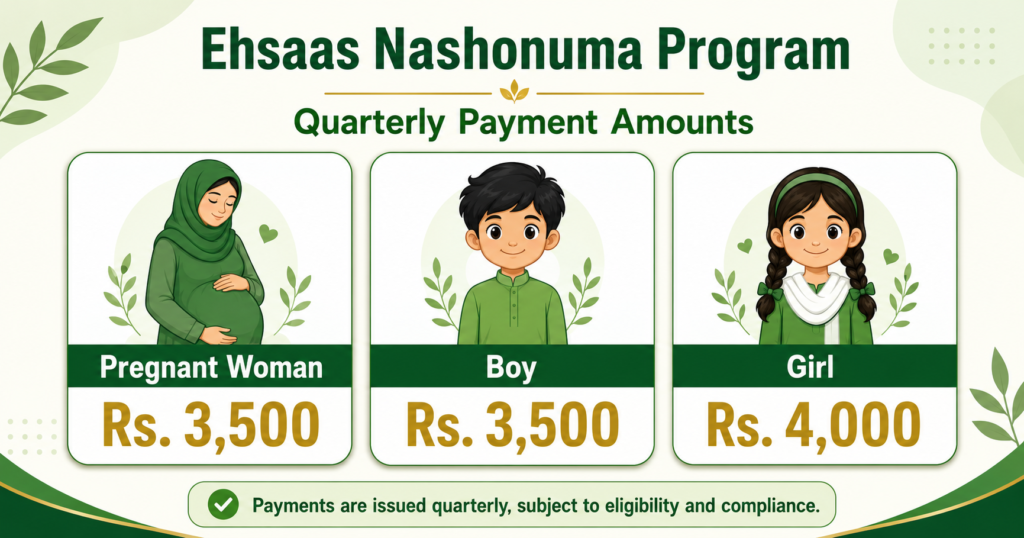
A higher amount is provided for a girl child as part of the programme’s gender-responsive design. BISP states that conditional cash assistance may reach up to Rs.42,500 per beneficiary over the applicable participation period.
A child leaves or “graduates” from the programme upon reaching two years of age. The amount received by a family can vary according to the beneficiary’s enrolment stage, compliance record and length of participation.
Who Is Eligible for the Ehsaas Nashonuma Program?
An applicant generally needs to meet the following official conditions:
- She must be an active Benazir Kafaalat beneficiary.
- She must be pregnant at any stage or breastfeeding.
- An eligible woman should be between 18 and 59 years old.
- A child registered under the programme must be under two years old.
- The beneficiary must live in an operational programme area.
- Pregnancy must be confirmed through a registered health facility.
- The family must provide valid identification and health records.
Eligibility is based on BISP and National Socio-Economic Registry data. Simply being pregnant or having a child under two does not automatically guarantee acceptance if the family is not eligible under Benazir Kafaalat.
Women who have not yet joined Kafaalat can read our Ehsaas Kafalat Program 2026 CNIC check and 8171 registration guide to understand the eligibility and registration process.
Documents Required for Registration
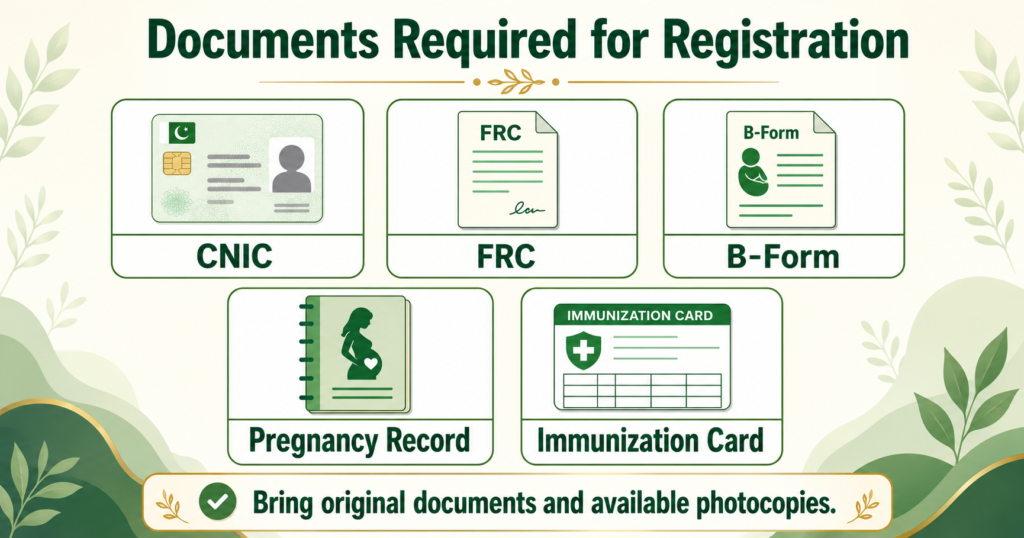
Applicants should take the original documents and available photocopies to the nearest facilitation centre:
- Mother’s valid CNIC
- Husband’s CNIC, if requested
- Child’s B-Form or NADRA Family Registration Certificate
- Pregnancy confirmation or medical record
- Child’s EPI immunization card
- Active mobile number registered or used by the family
- Benazir Kafaalat beneficiary information
- Previous health or growth-monitoring record, if available
Requirements can differ slightly according to pregnancy status, the child’s age and local verification procedures. Applicants should not give original documents permanently to an unofficial agent.
How to Apply for the Ehsaas Nashonuma Program
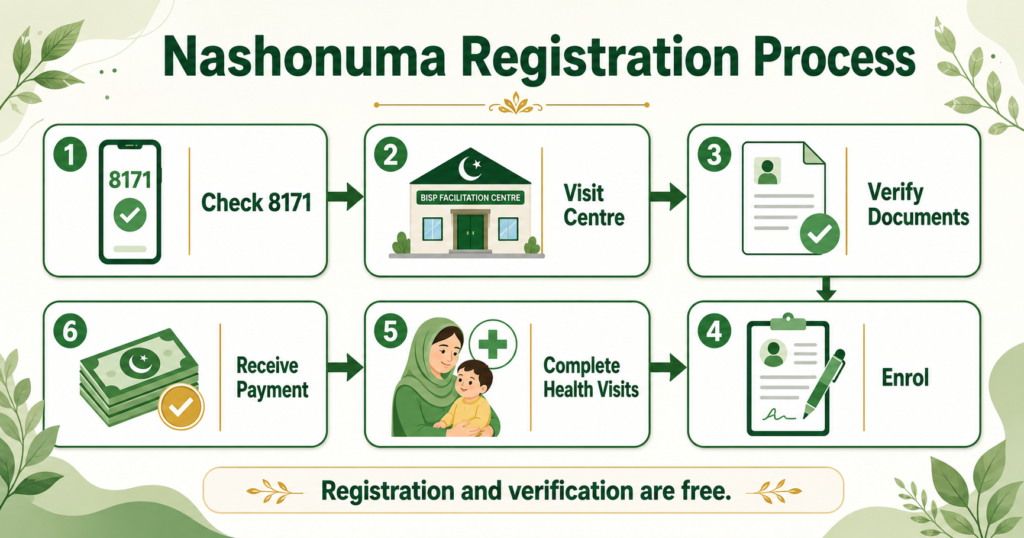
There is no general online application form through which a woman can complete the entire Nashonuma enrolment process from home. Physical verification at an authorized centre is required because pregnancy, health records and child information must be checked.
Step 1: Check BISP Eligibility Through 8171
Visit the official 8171 web portal and enter the woman’s CNIC number and the displayed security code. The portal can show household eligibility information.
Applicants may also wait for an official message from 8171. Messages received from other numbers should not be treated as official BISP notifications.
Step 2: Update the NSER Survey if Necessary
If the household is not present in BISP records or its information is outdated, visit the nearest BISP Dynamic Registration Centre. Bring the household’s identity documents and provide accurate socioeconomic information.
Completing a survey does not guarantee acceptance. BISP evaluates households according to the applicable eligibility rules.
Step 3: Locate a Nashonuma Facilitation Centre
Eligible women should ask the nearest BISP tehsil office, government health facility or BISP helpline about their closest Nashonuma Center. Many centres operate inside or close to public-sector hospitals.
Step 4: Submit Documents and Complete Screening
At the centre, staff will verify the CNIC, Kafaalat status, pregnancy or child information, FRC and immunization records. A pregnant applicant may undergo screening at a registered health facility.
Step 5: Complete Digital Enrolment
Authorized staff enter the information into the programme’s digital system. The platform is integrated with BISP and NADRA for registration, verification, compliance monitoring and payments.
Step 6: Follow the Health Schedule
After enrolment, the woman must attend scheduled checkups, nutrition sessions and follow-up visits. A registered child must receive immunization and regular growth monitoring.
Conditions for Receiving Quarterly Payments
Beneficiaries are required to comply with the programme’s health conditions. These normally include:
- Attending antenatal visits during pregnancy
- Completing postnatal checkups after delivery
- Participating in health and nutrition awareness sessions
- Consuming specialized nutritious food as directed
- Following the national immunization schedule
- Bringing the child for quarterly growth monitoring
- Updating birth and child records when required
Missing appointments or failing to meet compliance requirements may delay a payment. A beneficiary facing a medical or administrative problem should contact centre staff instead of using a private agent.
Benefits Beyond Cash Assistance
Financial support is only one part of the Ehsaas Nashonuma Program. Enrolled families may also receive:
Specialized nutritious food
Pregnant and breastfeeding women and children under two receive specially formulated nutrition products according to programme guidelines.
Maternal healthcare
The initiative promotes antenatal and postnatal care, pregnancy monitoring and counselling intended to reduce health risks.
Families seeking information about hospital treatment coverage can also review the Sehat Sahulat Card 2026 eligibility check and hospital guide.
Child-growth monitoring
Health staff record a child’s weight, growth and nutritional condition. Early identification helps families obtain appropriate treatment or referrals.
Immunization support
Parents are encouraged to complete routine vaccinations according to Pakistan’s Expanded Programme on Immunization schedule.
Nutrition and hygiene education
Sessions cover breastfeeding, complementary feeding, dietary diversity, clean water, sanitation and household hygiene.
Programme Coverage and Results
The Ehsaas Nashonuma Program began as a pilot in August 2020 in nine districts and later expanded to 15 districts. It is now operational in 158 districts through 558 centres, including mobile facilities.
Official programme information reports 169 Nutrition Stabilization Centres and treatment for approximately 53,000 children with complicated severe acute malnutrition, with a cure rate above 97%.
An Aga Khan University impact evaluation reported encouraging outcomes, including a lower risk of stunting, improved immunization coverage and reductions in child anemia. BISP’s 2026 programme page states that the risk of stunting at 12 months was 18% lower among beneficiaries, equivalent to a 10.1-percentage-point reduction.
How to Avoid Nashonuma Registration Fraud
Registration and the BISP survey are free. Families should follow these precautions:
- Trust SMS messages only from 8171.
- Never pay an agent for registration or approval.
- Do not share an ATM PIN, verification code or payment password.
- Use only the official 8171 portal to check eligibility.
- Obtain a receipt after collecting a payment.
- Report illegal deductions immediately.
- Call the BISP helpline at 0800-26477 for assistance.
Frequently Asked Questions
Supporting Healthy Mothers and Children
The Ehsaas Nashonuma Program provides a practical combination of financial assistance, nutrition supplies and essential healthcare during the most important stage of a child’s development. Eligible families should check their status through 8171, visit an authorized Nashonuma centre and maintain all required health appointments.
Payment rates and administrative procedures can change. Applicants should therefore confirm the latest information through the official BISP website or helpline before registration.
Related Post:
URAAN Summer Scholars Program 2026: Eligibility, Stipend and Application Guide