Sehat Sahulat Card 2026 – 8500 Eligibility Check and Hospital List
The Sehat Sahulat Card is a government-supported health insurance facility designed to protect families from the financial burden of hospital treatment. It enables eligible residents of Punjab to receive inpatient healthcare at selected private hospitals without paying the entire medical bill themselves.
However, important policy changes have been introduced. The program has not been completely discontinued, but its operation in Punjab is different from earlier years. Treatment under the card is currently available through empaneled private hospitals, while government hospitals continue providing healthcare through the regular public healthcare system.
Some major services, including cancer treatment, intensive care, emergency admission, thalassemia care and certain medical cases, may remain fully covered. For several other treatments, the card pays 50% of the approved cost while the patient’s family pays the remaining 50%. Therefore, patients should confirm coverage with the hospital before admission.
This detailed guide explains the Sehat Sahulat Card 2026 eligibility rules, 8500 CNIC check, treatment coverage, hospital process, documents, limitations and complaint procedure.
Important update: Never assume that every procedure is completely free. Confirm the treatment package, remaining limit and possible co-payment with the hospital’s Sehat Card counter before admission.
What Is the Sehat Sahulat Card?
The Sehat Sahulat Card, also known as the Sehat Insaf Card or Health Card, is a social health protection initiative. It helps eligible families receive inpatient medical and surgical treatment at hospitals included in the government-approved network.
A separate plastic card is generally not necessary. According to the Punjab Health Initiative Management Company, the original computerized national identity card of an eligible person works as the health card.
The program primarily protects families from expensive hospital bills resulting from serious illnesses, operations and medical emergencies. It does not work like a monthly cash-assistance scheme. Beneficiaries cannot withdraw the available amount as cash.
Its main features include:
- Cashless or partly subsidized inpatient treatment
- Access to selected private hospitals
- Coverage for pre-existing medical conditions
- Emergency and priority healthcare services
- Coverage for eligible family members
- Treatment portability at participating hospitals
- Medicines and diagnostic tests during admission
- Financial protection against major hospital expenses
Families looking for direct financial assistance can separately review the Ehsaas Kafalat Program 2026 CNIC check and 8171 registration guide.
Is the Sehat Card Still Working in Punjab in 2026?
Yes, the Sehat Sahulat Card has not been completely stopped in Punjab. According to the official PHIMC clarification, services under the program continue at empaneled private hospitals.
The program is no longer being used in Punjab’s government hospitals under the revised policy. Public hospitals continue treating patients through the government healthcare system instead of processing their treatment through the health insurance card.
The official policy currently divides treatment into two broad categories:
| Treatment category | Current payment arrangement |
|---|---|
| Cancer, ICU, CCU and NICU | Covered according to the approved program rules |
| Thalassemia and emergency services | Covered according to approved packages |
| Qualifying medical cases | May be fully covered |
| Many other medical or surgical treatments | 50% card coverage and 50% patient payment |
| OPD consultation | Not covered |
| Excluded procedures | Paid by the patient |
Because packages and hospital participation can change, call the helpline or contact the hospital before travelling.
Sehat Sahulat Card Eligibility Criteria
The official Punjab FAQ states that all permanent residents of Punjab are eligible for the program. Eligibility depends on the applicant’s residential and family information in the NADRA database.
Basic requirements include:
- The applicant must be a permanent resident of Punjab.
- The applicant must possess a valid NADRA-issued CNIC.
- The CNIC should show updated residential information.
- The family record must be correctly registered with NADRA.
- Children should be registered through their B-Form.
- Husband, wife and unmarried children should appear in the same family record.
The covered family generally consists of the husband, wife and their unmarried children. A newborn delivered at an empaneled hospital may be added automatically. For other newborns or children under 18, parents may need to present a valid B-Form at the hospital helpdesk.
Sehat Sahulat Card 8500 Online Check
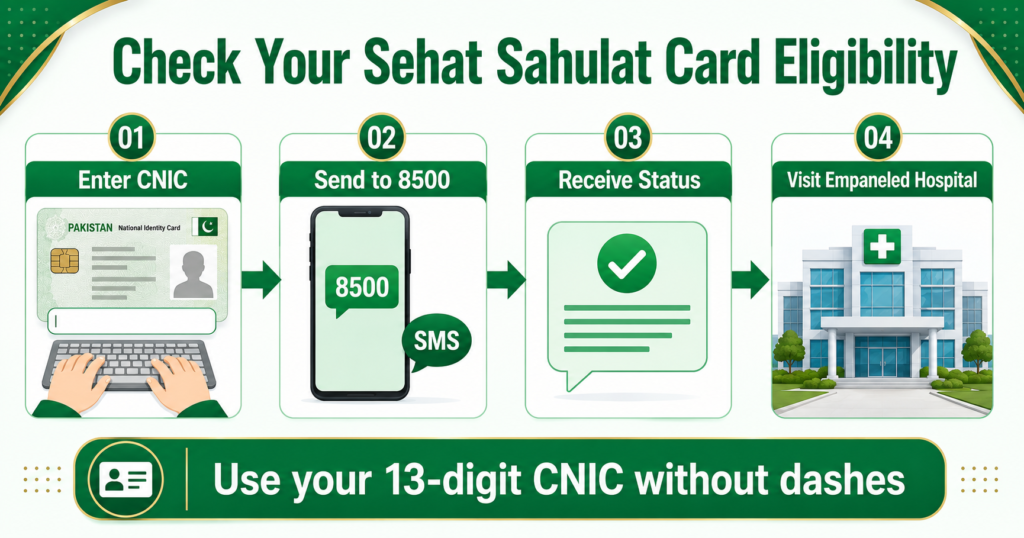
The easiest way to check your Sehat Sahulat Card status is through the official 8500 SMS service.
Follow these steps:
- Open the messaging application on your mobile phone.
- Enter your 13-digit CNIC number without dashes.
- Send the CNIC number to 8500.
- Wait for the eligibility response.
- Save the confirmation message for your record.
For example, write 3520212345671 instead of 35202-1234567-1.
A normal SMS charge may apply. Use a SIM that is active and preferably registered against your CNIC. Never send your CNIC, PIN, bank information or verification code to an unofficial number.
Applicants can also use the eligibility link available through the official PHIMC information page.
Is Online Registration Required?
There is normally no separate form for general Sehat Sahulat Card registration in Punjab. Eligibility is generated from NADRA’s identity, address and family-registration data.
If 8500 shows that you are eligible, you can visit an empaneled hospital with your original CNIC. You do not have to purchase a card, pay an agent or complete registration through an unofficial website.
If you are a permanent Punjab resident but receive an ineligible response:
- Check the address on your CNIC.
- Visit the nearest NADRA registration centre.
- Update your permanent address if it is incorrect.
- Correct your marital or family-registration information.
- Register missing children and obtain their B-Forms.
- Check your status again after NADRA updates the record.
Avoid websites claiming they can guarantee approval after receiving a registration fee.
Required Documents
Keep the following documents ready when checking eligibility or visiting a hospital:
- Original CNIC of the patient
- Original CNIC of the family head
- B-Form for a patient below 18 years
- 8500 eligibility confirmation, if available
- Doctor’s prescription, medical history and test reports
- Referral letter, where required
- Updated NADRA family information
A physical Sehat Sahulat Card is not compulsory when the patient’s CNIC is recognized as eligible.
Treatment Covered Under the Program
The program focuses on treatments that require hospital admission. According to PHIMC, covered services can include:
- Emergency hospital admission
- Inpatient medical treatment
- Major and minor surgical procedures
- Heart angioplasty and bypass surgery
- Cancer surgery, chemotherapy and radiotherapy
- ICU, CCU and NICU care
- Treatment of diabetes-related complications
- Fractures and serious injuries
- Burns and road-traffic accident treatment
- Neurosurgical procedures
- Thalassemia treatment
- Hepatitis and other chronic infections
- Life- or limb-saving treatment
- Prostheses in approved accident cases
- Medicines, laboratory tests and diagnostics during admission
Pre-existing illnesses can also be covered. However, treatment must satisfy the program’s clinical criteria and approved package rules.
Pregnant women and mothers needing nutrition-related assistance can separately check the Ehsaas Nashonuma Program registration and payment guide.
Eligible mothers in Khyber Pakhtunkhwa may also explore the Ehsaas Maa Program offering Rs.20,000 assistance for mothers, as it is separate from Sehat Card hospital coverage.
Treatments Not Covered
The Sehat Sahulat Card does not cover every healthcare expense. The official exclusions include:
- Routine outpatient consultations
- OPD medicines and laboratory tests
- Normal delivery and C-section
- Cosmetic or beauty procedures
- Dental treatment
- Eyeglasses
- Drug-addiction treatment
- Self-inflicted injuries
- Injuries resulting from criminal activity
- Procedures excluded by the insurance policy
The card does not normally pay for a routine doctor’s appointment when the patient is not admitted. Diagnostic tests and medicines are covered only when connected with an approved hospital admission.
Coverage Limit in Punjab
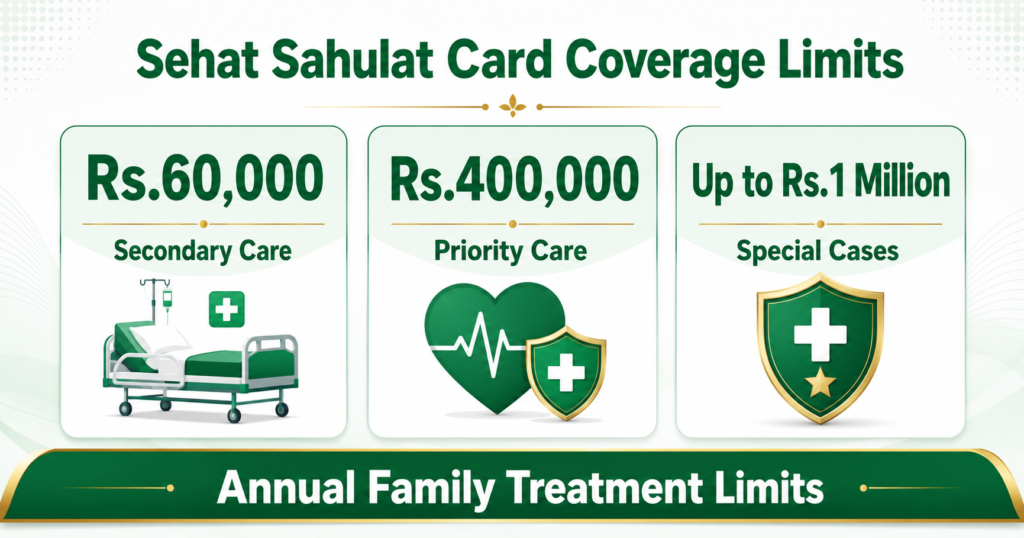
The official PHIMC FAQ lists the following annual family limits:
- Secondary care: Up to Rs.60,000 per family per year
- Priority care: Up to Rs.400,000 per family per year
- Special cases: Extension may be available up to Rs.1 million
Coverage is shared by the eligible family rather than separately assigned to every individual. There is no stated restriction based simply on the number of family members.
If the available limit ends during an approved admission, ongoing treatment may continue until recovery. Life-threatening emergencies may also receive consideration after the normal limit has been exhausted.
These figures represent treatment limits, not a cash balance. Any unused amount cannot be withdrawn or transferred.
How to Use the Card at a Hospital
Follow this procedure to receive treatment:
- Find an empaneled private hospital offering the required specialty.
- Call the hospital to confirm its current participation.
- Visit the hospital with the patient’s original CNIC or B-Form.
- Go to the dedicated Sehat Card or Hospital Facilitation Officer counter.
- Ask the doctor to evaluate whether admission is medically required.
- Allow the counter staff to verify eligibility and available coverage.
- Request an explanation of the approved package and co-payment.
- Obtain authorization before admission or treatment.
- Keep copies of receipts, discharge papers and complaint records.
Do not assume that a hospital’s presence on an old online list guarantees current availability of every specialty. Hospitals may join, leave or offer only selected packages.
Sehat Sahulat Card Hospital List
The Punjab government maintains an official list of empaneled hospitals. It includes participating facilities in Lahore, Rawalpindi, Faisalabad, Multan, Bahawalpur, Gujranwala and other districts.
Examples appearing in the published Punjab list include:
- Arif Memorial Hospital, Lahore
- Akhtar Saeed Trust Hospital, Lahore
- Central Park Teaching Hospital, Lahore
- Bahria International Hospital Mohlanwal
- Farooq Hospital, Lahore
- Fatima Memorial Hospital, Lahore
- Gulab Devi Hospital, Lahore
- Sharif Medical City Hospital
- University of Lahore Teaching Hospital
- Shalamar Hospital, Lahore
Always verify the latest status through the official empaneled hospital section or helpline before visiting. Confirm that the hospital handles your required procedure under the current policy.
Helpline and Complaint Procedure
If a hospital refuses an apparently covered service, first speak to the Hospital Facilitation Officer. Confirm that the case requires admission, the procedure is not excluded and sufficient coverage is available.
You may then contact PHIMC:
- Eligibility SMS: 8500
- 24/7 helpline: 0800-09009
- Additional numbers: 0333-6756390, 042-99066000 and 042-99066001
- Email: info@phimc.punjab.gov.pk
- Official website: Punjab Health Initiative Management Company
Keep the patient’s CNIC, hospital name, admission date, doctor’s recommendation and any written refusal ready when filing a complaint.
Important Safety Tips
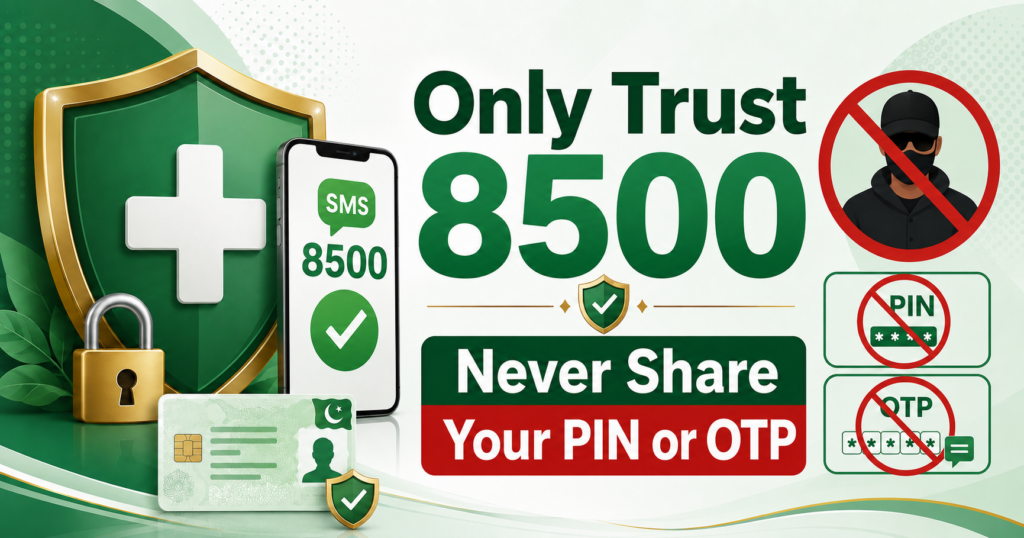
Protect yourself from fake registration agents and fraudulent messages:
- Send your CNIC only to the official 8500 service.
- Never pay anyone for guaranteed eligibility.
- Do not share your ATM PIN or one-time password.
- Verify hospitals through official sources.
- Ask for a written breakdown of co-payment.
- Obtain receipts for every amount paid.
- Never hand your original CNIC to an unauthorized agent.
Frequently Asked Questions
Latest Sehat Sahulat Card Punjab Update
The Sehat Sahulat Card continues to offer important financial protection to permanent residents of Punjab, particularly during serious illness and medical emergencies. However, patients must understand the latest rules: treatment is currently provided through empaneled private hospitals, OPD is excluded, and a 50% patient contribution can apply to many procedures.
Check your eligibility through 8500, verify the hospital and request complete cost information before admission. Using only official channels will help you receive accurate information and avoid fraudulent registration offers.
Related Posts: