Ehsaas Emergency Cash Program: Rs 12,000 Complete Guide
The Ehsaas Emergency Cash Program was introduced by the Government of Pakistan in 2020 to assist families whose incomes were affected by the COVID-19 lockdown. Daily-wage workers, labourers, small vendors, domestic workers and other vulnerable households suddenly found themselves unable to meet basic expenses because economic activity had stopped.
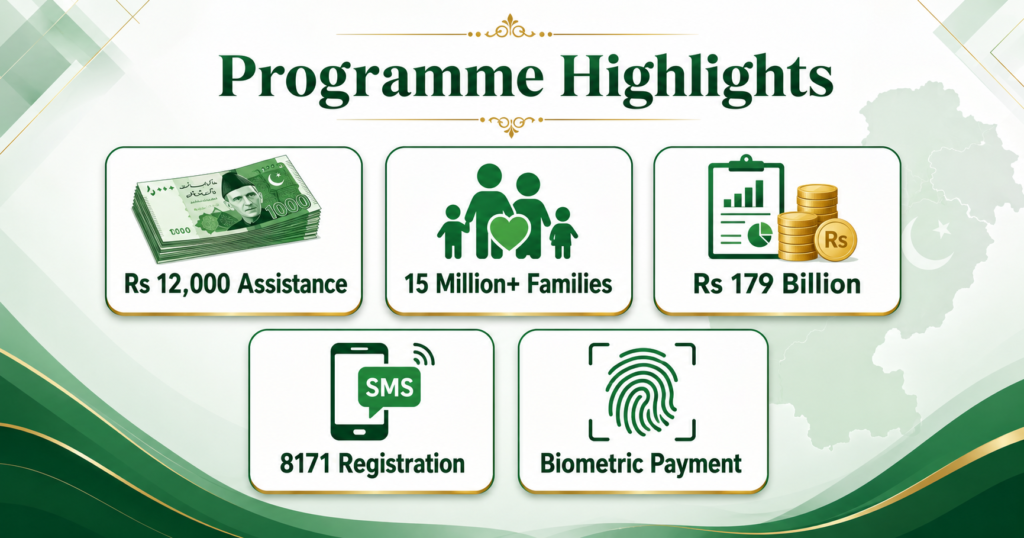
Under this initiative, eligible families received a one-time payment of Rs 12,000. The programme initially aimed to support 12 million households through a budget of Rs 144 billion. It was later expanded, and more than 15 million families received assistance across Pakistan.
It is important to understand that the original Ehsaas Emergency Cash scheme was a temporary COVID-19 relief initiative. Its main payment period occurred in 2020, and it should not be confused with regular programmes currently administered by the Benazir Income Support Programme. People looking for ongoing support should check the official BISP system instead of relying on websites claiming that new emergency cash registration is open.
Ehsaas Emergency Cash Program Overview
| Programme detail | Information |
|---|---|
| Programme name | Ehsaas Emergency Cash |
| Launch year | 2020 |
| Purpose | Emergency financial support during COVID-19 |
| Original payment | Rs 12,000 per eligible family |
| Original target | 12 million families |
| Initial budget | Rs 144 billion |
| Expanded disbursement | Approximately Rs 179 billion |
| Families supported | More than 15 million |
| Registration channel | 8171 SMS and online portal |
| Identification requirement | Valid CNIC |
| Payment verification | NADRA biometric verification |
| Coverage | Pakistan, AJK and Gilgit-Baltistan |
| Current status | Original COVID-19 application phase has ended |
Official programme information states that approximately Rs 179 billion was delivered to over 15 million families. The government used mobile phones, CNIC records, the National Socio-Economic Registry and biometric payment systems to distribute assistance on a large scale. (Ehsaas 2047)
What Was the Ehsaas Emergency Cash Programme?
The programme was a one-time social protection response developed to reduce the economic effects of the coronavirus crisis. Lockdowns severely affected workers who depended on daily earnings, including construction labourers, rickshaw drivers, shop workers, street vendors and piece-rate employees.
Each approved family was supposed to receive Rs 12,000 for immediate subsistence. This amount represented four months of emergency support calculated at Rs 3,000 per month.
Unlike a conventional application system based entirely on physical forms, the programme used an 8171 SMS service, an online registration portal, CNIC-based data analysis and biometric verification. These systems allowed the government to process millions of requests while reducing duplication and political interference.
The World Bank reportedly ranked the initiative among the world’s largest COVID-19 social protection responses based on the number and percentage of people covered.
Is Ehsaas Emergency Cash Registration Open in 2026?
No official announcement currently confirms a fresh nationwide 2026 registration round under the original COVID-era Ehsaas Emergency Cash Program.
The original assistance was designed specifically for families affected by the 2020 pandemic emergency. Official records also referred to the closure of its main payments in 2020. Therefore, websites or social media posts advertising guaranteed “Ehsaas Emergency Cash 2026 payments” should be treated carefully.
Pakistan’s continuing federal cash assistance is now primarily administered through BISP. Deserving households can visit a BISP Tehsil Office for the NSER Dynamic Survey and check official messages received from 8171.
Applicants interested in regular quarterly assistance should read our Ehsaas Kafalat Program 2026: Check CNIC and Register Through 8171 guide. Families needing nutritional support for pregnant women and young children can also explore the Ehsaas Nashonuma Program: Registration and Payments.
How the 8171 Registration System Worked
During the emergency phase, the Ehsaas Emergency Cash registration process began through the 8171 short code. A person sent their CNIC number by SMS and the submitted record was checked against government databases.
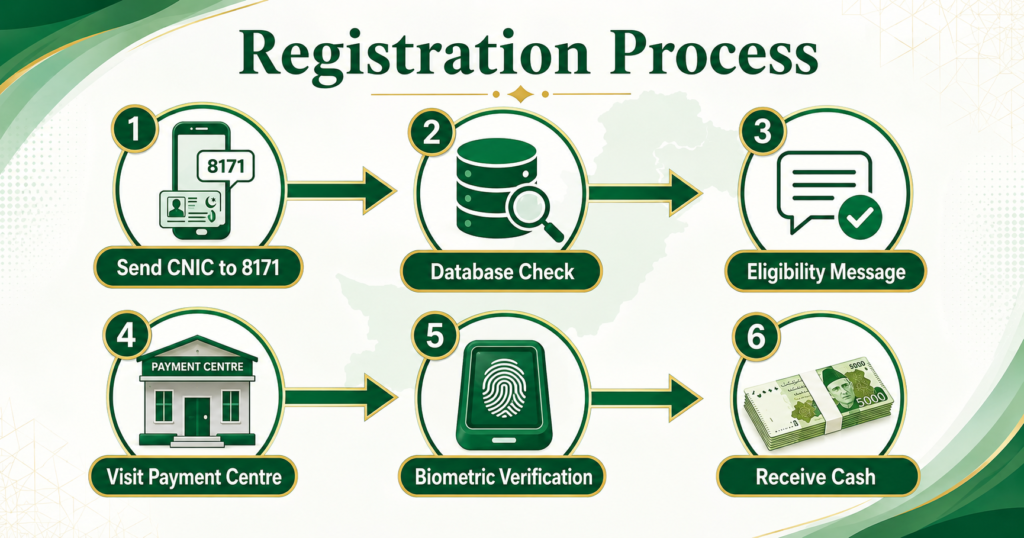
The process generally worked as follows:
- The applicant entered their 13-digit CNIC number without dashes.
- The CNIC was sent by SMS to 8171.
- Government databases checked the applicant’s household and financial information.
- Eligible applicants received further payment instructions.
- Some applicants not found in the database were referred for district-level verification.
- Approved beneficiaries collected payment after biometric verification.
This procedure applied during the active emergency campaign. Sending a CNIC to 8171 today does not automatically create a new application for the closed COVID-19 payment. However, 8171 remains BISP’s official communication number for its current programmes. BISP warns citizens not to trust messages received from other numbers. (BISP Latest News)
Who Was Eligible for Rs 12,000 Emergency Cash?
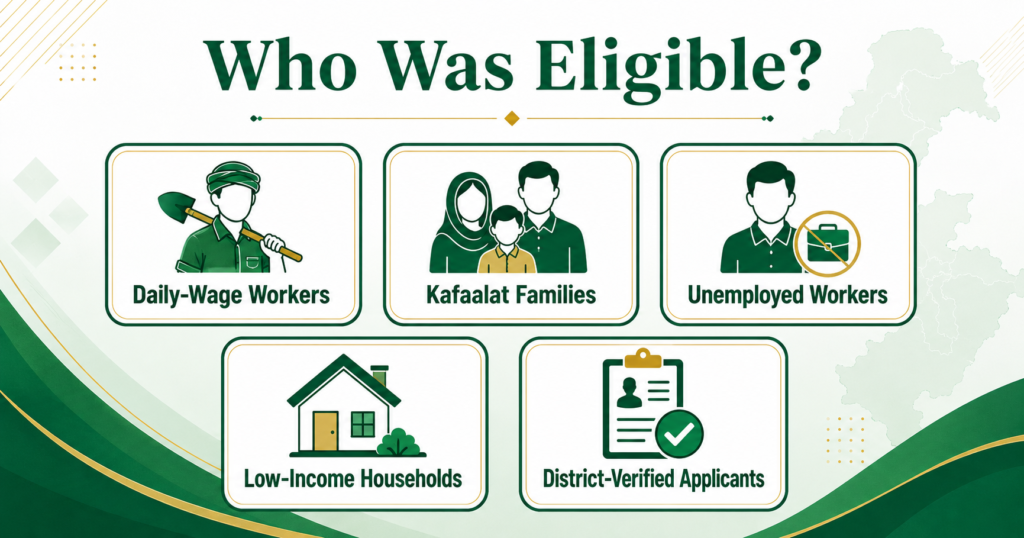
The programme targeted households experiencing serious economic hardship because of COVID-19. Its main beneficiaries included:
- Existing Kafaalat beneficiary families
- Daily-wage and piece-rate workers
- Labourers whose workplaces closed
- Low-income households recorded in the NSER
- Workers who lost employment during lockdown
- Vulnerable families verified by district administrations
- Households classified as the “new poor” after losing income
The selection system combined existing poverty data with requests received through SMS and the web portal. This hybrid approach allowed the government to assist both previously identified vulnerable households and people who had recently fallen into financial difficulty.
Families struggling with food expenses may also find useful information in our Ehsaas Rashan Program guide.
How Beneficiaries Were Selected
The Ehsaas 8171 CNIC check was not the only stage of verification. NADRA and the relevant government departments used several data sources to assess each request.
These sources included:
- National Socio-Economic Registry information
- CNIC and family registration records
- Government employment status
- Vehicle ownership information
- Property and asset indicators
- Tax records
- Utility billing information
- History of repeated foreign travel
Applicants identified as government employees, financially stable individuals or owners of significant assets could be excluded. This data-based method was designed to reduce inclusion errors and reserve limited public funds for households experiencing genuine hardship.
Categories of Emergency Cash Beneficiaries
The original plan divided beneficiaries into different categories.
Category 1: Existing Kafaalat Beneficiaries
Approximately 4.5 million families already enrolled in Kafaalat were included. These households received a lump-sum payment covering four months of assistance.
Category 2: Newly Identified Vulnerable Families
Other eligible households were selected using a higher poverty threshold in the National Socio-Economic Database. This group included families that were not previously receiving regular Kafaalat payments but became vulnerable during the pandemic.
District-Verified Applicants
People who were absent from the database could be referred to their district administration. District officials entered the information of potentially deserving applicants into a secure portal for additional verification.
The final programme expanded beyond its initial targets. An official government press release from July 2020 stated that the budget was increased to Rs 203 billion with a target of approximately 16.9 million families. (BISP press release)
Documents Required for Verification
The emergency application was designed to require limited paperwork. The most important requirement was a valid computerized national identity card.
Applicants generally needed:
- Original CNIC
- Mobile number used for registration
- Active SIM where instructions could be received
- Household information matching NADRA records
- Proof requested during district verification, if applicable
At a payment centre, the beneficiary’s fingerprints were verified through NADRA before cash was released. A photocopy of a CNIC or an SMS screenshot alone was not sufficient to collect payment.
How the Rs 12,000 Payment Was Collected
Approved beneficiaries were informed about their payment location through an official message. Payments were issued through biometrically enabled branchless banking agents, temporary campsites, Points of Sale and supported ATMs.
The beneficiary had to:
- Wait for confirmation from 8171.
- Visit the assigned payment location.
- Present the original CNIC.
- Complete biometric fingerprint verification.
- Collect the full approved amount.
- Request a printed receipt where available.
- Count the cash before leaving the counter.
The government established thousands of digital payment points across Pakistan. Payments covered Punjab, Sindh, Khyber Pakhtunkhwa, Balochistan, Islamabad, Azad Jammu and Kashmir and Gilgit-Baltistan.
What to Do If Biometric Verification Fails
Fingerprint verification can fail because of age, worn fingerprints, damaged skin or a technical problem. During an active payment cycle, affected beneficiaries were usually instructed to try another biometric device or contact the responsible BISP or NADRA office.
A failed fingerprint scan did not mean applicants should pay an agent. Beneficiaries were advised to follow the official complaint process and never hand over their CNIC to an unauthorized person.
How to Check Current BISP Assistance
Anyone seeking financial help in 2026 should use the current BISP process:
- Visit the official BISP website.
- Use only the official 8171 web portal when available.
- Visit the nearest BISP Tehsil Office.
- Complete or update the NSER Dynamic Survey.
- Keep the original CNIC and registered mobile number available.
- Wait for an SMS sent specifically from 8171.
BISP reports that its NSER contains data for millions of households and uses the Proxy Means Test to determine programme eligibility. (BISP NSER)
People planning to start a small business should not confuse emergency cash with financing. They can instead review the 8171 Ehsaas Loan: Eligibility and Application Guide for relevant information.
Ehsaas Emergency Cash Fraud Prevention
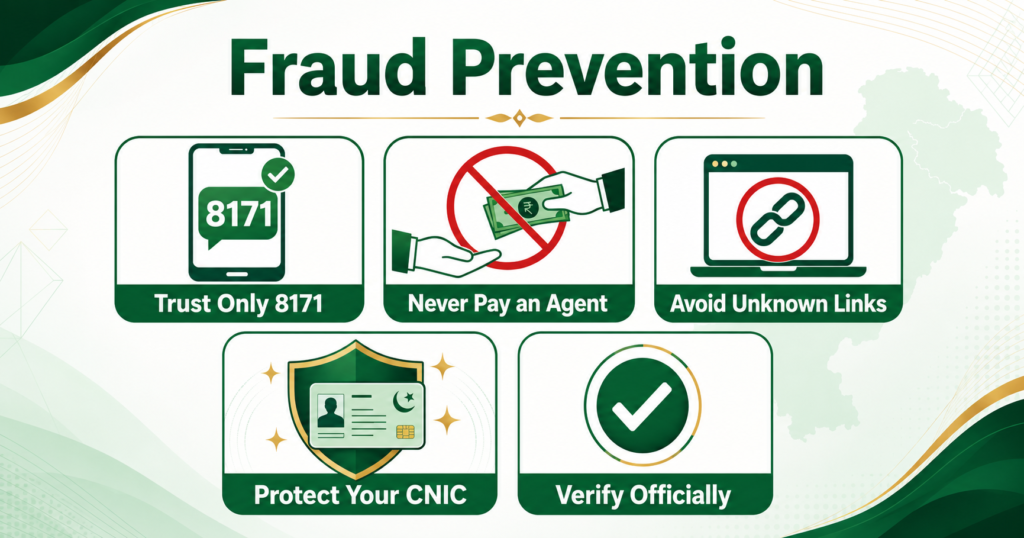
Scammers often reuse the names of popular welfare programmes. Protect yourself by following these precautions:
- Trust programme messages only when they come from 8171.
- Never share an OTP, PIN or bank password.
- Do not pay an agent for registration or approval.
- Avoid unofficial mobile applications claiming to release payments.
- Never click an unknown link received through WhatsApp.
- Do not give your original CNIC to an unauthorized person.
- Verify new schemes through BISP or another relevant government department.
- Report illegal deductions from an approved payment.
No private agent can change a household’s poverty score, guarantee eligibility or activate a closed payment.
Importance of the Programme
The programme demonstrated how digital systems could deliver emergency social protection quickly. Approximately 139 million requests were received, including around 66 million unique requests. More than 14.8 million individuals reportedly collected payments.
Its combination of mobile registration, CNIC verification, poverty data and biometric payments provided an important model for responding to national emergencies. It also showed the value of maintaining updated household records before a crisis occurs.
However, its historical success should not be used to advertise nonexistent registrations. Any new payment, amount or application deadline requires a fresh official government announcement.
Frequently Asked Questions
Final Words
The Ehsaas Emergency Cash Program was one of Pakistan’s largest emergency social assistance initiatives. It provided Rs 12,000 to millions of families whose livelihoods were disrupted during the COVID-19 crisis. Its use of 8171, CNIC-based checks, poverty data and biometric payments helped deliver assistance across the country.
Nevertheless, the original scheme should be presented as a historical emergency programme—not as an automatically active 2026 payment. People seeking help today should rely on official BISP announcements, complete the NSER survey where required and ignore agents promising guaranteed cash in exchange for money.