
Nawaz Sharif Schools of Eminence 2026: Phase 2 Guide
The Nawaz Sharif Schools of Eminence initiative is an educational development project introduced by the Punjab Education Foundation to establish modern, inclusive and technology-supported schools throughout Punjab. Instead of operating these institutions entirely through the traditional government-school system, PEF plans to work with qualified private partners under a performance-linked public-private partnership model.
Successful applicants will be responsible for establishing and operating the proposed schools according to PEF’s infrastructure, academic, staffing and technology standards. In return, PEF will provide a monthly subsidy based on the number and grade level of verified students.
The programme targets individuals, young entrepreneur groups, educational chains, Ed-Tech companies, universities and eligible non-governmental organisations with the qualifications, experience and financial capacity to manage a modern school.
Importantly, the Phase 2 application process is primarily for prospective school operators or licensees. It is not the same as a student-admission or teaching-job application. Parents and job seekers should wait for admission and recruitment announcements from operational campuses.
This guide explains the NSSE Phase 2 eligibility criteria, subsidy rates, infrastructure conditions, required documents and application procedure using information available in the official PEF Terms of Reference.
NSSE Phase 2 Latest Update: Application Deadline and Results
The Punjab Education Foundation’s Phase 2 advertisement lists 6 July 2026 as the application deadline. This is later than the 30 June date mentioned in earlier information. Applicants should treat this as a past deadline, rather than an active invitation to apply.
The programme has also progressed to the results stage. According to PEF, a Phase II result-finalization meeting took place on 13 August 2026, chaired by Punjab Education Minister Rana Sikandar Hayat. The meeting reviewed and finalized the Phase II results.
Existing applicants should check official PEF notices for results and any further instructions. Finalization of results does not mean that every applicant has been selected or that applications have reopened.
Official information: Phase 2 advertisement and amended TORs | Phase II result-finalization announcement
What Are Nawaz Sharif Schools of Eminence?
The Nawaz Sharif School of Eminence model aims to provide high-quality education through schools equipped with modern classrooms, laboratories, digital systems and professionally qualified teachers.
The project has been developed by the Punjab Education Foundation, commonly known as PEF. PEF promotes access to education through partnerships between the government and private education providers.
Under this arrangement, selected partners receive a renewable licence to establish and manage a school. Their performance is monitored through student assessments, enrolment verification, inspections, financial reviews and compliance checks.
The official vision includes:
- Equitable access to quality education
- Technology-enabled teaching and learning
- AI-supported classrooms
- Science, IT and STEAM laboratories
- Digital libraries and learning-management systems
- Qualified and professionally trained teachers
- Inclusive education for girls and marginalised communities
- Student counselling and life-skills education
- Sports and co-curricular activities
- Transparent governance and community participation
These features distinguish PEF Schools of Eminence from an ordinary school-building project. The programme connects financial support with measurable academic and operational performance.
Who Can Apply for NSSE Phase 2?
Applications for NSSE Phase 2 were invited under several categories. These include:
- Individuals
- Young Entrepreneur Groups
- Educational chains
- Ed-Tech firms
- NGOs and civil-society organisations
- Eligible degree-awarding institutions and universities
The exact requirements differ between categories. An applicant should therefore read the category-specific Terms of Reference instead of assuming that one set of conditions applies to everyone.
Where multiple applicants compete for the same location, the official Phase 2 TORs list the priority order as individuals, young entrepreneur groups, educational chains, Ed-Tech firms and NGOs/CSOs.
NSSE Eligibility Criteria for Individual Applicants
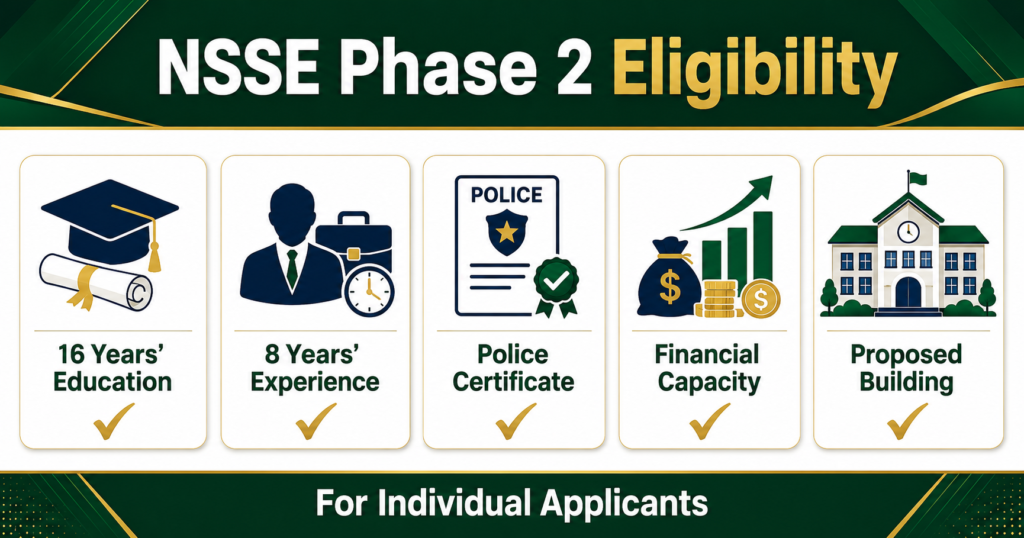
An individual applying for an NSSE school licence must generally meet the following conditions:
- Have at least 16 years of education from an HEC-recognised university
- Possess at least eight years of post-qualification experience
- Provide an original police character certificate
- Submit an affidavit of compliance on Rs.300 stamp paper
- Provide legal documents for the proposed owned or rented school building
- Demonstrate the required financial capacity
- Remain actively involved in the school’s operation and administration
Serving employees of government, semi-government and autonomous organisations are not eligible under the individual category.
Individual and young entrepreneur applicants may apply for a maximum of one school in one chosen tehsil, regardless of their district of domicile. Anyone already allocated a school under Phase 1 as an individual or young entrepreneur group member cannot apply again under the corresponding Phase 2 restriction.
Young Entrepreneur Group Requirements
A Young Entrepreneur Group gives qualified professionals an opportunity to jointly establish a school. Applicants should review the latest Phase 2 document carefully because group composition, education, experience, age and financial requirements can differ from the individual category.
PEF assesses whether group members have suitable professional capabilities, a workable management structure and sufficient financial resources. Applicants may need to provide:
- CNICs and recent photographs
- HEC-recognised degrees
- Experience certificates
- Police character certificates
- Affidavits of compliance
- Bank statements
- Tax returns
- Building ownership or rental documents
- A school-development and implementation plan
Members must disclose accurate information. False, forged or unverifiable documents can result in disqualification and legal action.
Financial Capacity Requirements
Financial capacity is an essential part of the NSSE eligibility criteria because PEF subsidy payments do not remove the licensee’s responsibility to establish and operate the school.
For an individual applicant, the Phase 2 TORs state a minimum working-capital requirement of:
| Proposed arrangement | Minimum working capital |
|---|---|
| Applicant owns the school building | PKR 7.5 million |
| Applicant uses a rented building | PKR 10 million |
PEF may examine the applicant’s latest tax return, declared assets and accumulated credit entries in bank statements for the six months before the application deadline.
These amounts are not described as grants paid to applicants. They represent the financial capacity the applicant must demonstrate. Applicants should not confuse the working-capital requirement with the monthly per-student subsidy.
NSSE Monthly Subsidy Rates
PEF will provide a monthly subsidy linked to verified student enrolment and performance. According to the official Phase 2 TORs, the announced rates are:
| Grade level | Monthly subsidy per student |
|---|---|
| ECE to Class 2 | Rs.3,500 |
| Classes 3–5 | Rs.4,000 |
| Classes 6–8 | Rs.4,500 |
| Classes 9–10, Arts | Rs.5,000 |
| Classes 9–10, Science | Rs.5,500 |
A school with air-conditioned classrooms throughout the campus may qualify for an additional Rs.300 per enrolled student, subject to verification.

The NSSE subsidy is linked to eligible and verified enrolment. It should not be treated as an unconditional fixed payment. PEF can monitor attendance, student records, academic performance, infrastructure and compliance before or during payment processing.
The programme also provides free textbooks for enrolled students, according to the operational support described in PEF’s framework.
Infrastructure Requirements
A proposed School of Eminence in Punjab must provide considerably more than basic classrooms. The premises and facilities are expected to meet PEF’s prescribed standards.
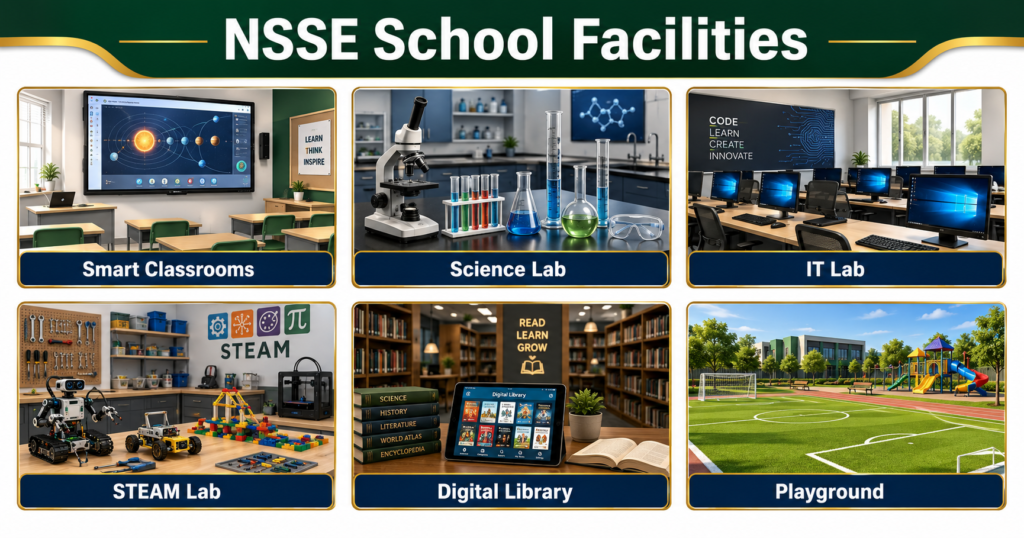
Major requirements include:
- At least 20 classrooms
- Science laboratory
- IT laboratory
- STEAM laboratory
- Digital library
- Smart learning facilities
- Separate and adequate toilets
- Safe drinking-water arrangements
- CCTV and security measures
- Biometric or technology-based attendance
- Playground or sports area
- Accessibility and child-safety arrangements
- Sufficient classroom space for enrolled students
The Phase 1 framework stated a minimum site size of approximately three to four kanals in metropolitan or municipal corporation areas and four to six kanals within urban municipal committee limits. Phase 2 applicants must follow the specifications stated for their listed site and category in the latest TORs.
Uploading details of the proposed building is an important part of the NSSE Phase 2 application. The applicant should possess valid ownership papers, a rental agreement or other legally acceptable documentation. Final selection remains subject to assessment of the proposed premises.
Academic and Staffing Standards
The project is intended to produce measurable educational outcomes. Licensees must therefore implement proper academic, assessment and teacher-development systems.
The schools are expected to:
- Follow the curriculum approved by the competent Punjab authority
- Recruit academically and professionally qualified teachers
- Use a learning-management system
- Track each student’s academic progress
- Provide continuous professional development for teachers
- Use AI and educational technology responsibly
- Conduct continuous assessment
- Offer sports, arts, debates and science activities
- Arrange counselling and life-skills programmes
- Maintain communication with parents
The earlier official framework required teachers to hold at least 16 years of education and complete more than 40 hours of continuing professional development annually. Applicants should verify whether their Phase 2 category contains any updated staffing conditions.
Quality Assurance and Monitoring
The public-private partnership school model gives the licensee operational responsibility, but PEF retains monitoring and quality-control authority.
Performance may be evaluated through:
- Quality Assurance Tests
- Academic and financial audits
- Student enrolment verification
- Teacher-attendance monitoring
- Campus inspections
- Digital performance dashboards
- Parent-teacher meetings
- Compliance and safety reviews
- Third-party evaluations
Under the earlier framework, the Quality Assurance Test standard required at least 75% of tested students to obtain a minimum of 40% marks. Schools were also expected to work towards an 85% BISE pass rate.
Failure to meet targets or comply with the agreement may affect payments, licence renewal or continuation of the partnership.
How to Apply for Nawaz Sharif Schools of Eminence
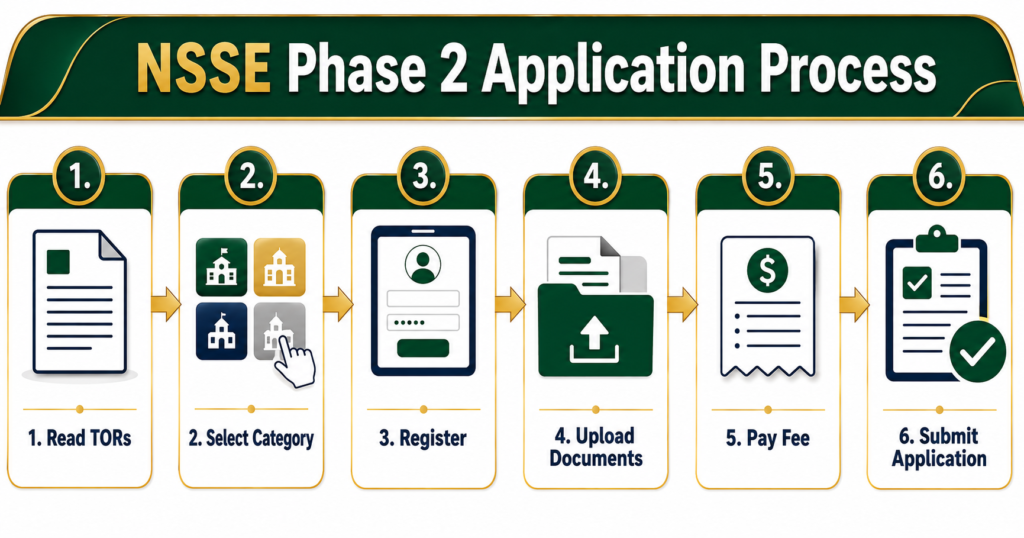
The exact submission method should always be confirmed from the current advertisement and official PEF portal. A typical NSSE application process includes the following steps:
- Visit the official Punjab Education Foundation website.
- Open the Nawaz Sharif Schools of Eminence Phase 2 section.
- Download and read the latest TORs.
- Select the correct applicant category.
- Review the available tehsil or site list.
- Register on the official application portal, if online submission is enabled.
- Enter personal or organisational information.
- Add education and professional-experience details.
- Upload financial and tax records.
- Add details and documents for the proposed building.
- Prepare the academic, infrastructure and implementation plan.
- Pay the prescribed non-refundable processing fee.
- Review the application and submit it before the deadline.
- Retain the receipt and application number for tracking.
The Phase 2 processing fee was Rs.100,000 for individuals and young entrepreneur groups. Education management organisations were required to pay Rs.100,000 for each tehsil included in their application, subject to the stated application limit.
Application Deadline Update
Earlier Phase 2 information mentioned 30 June 2026. However, the official PEF advertisement page lists 6 July 2026 as the application deadline.
That deadline has passed. The application period described in this guide should therefore be treated as closed unless PEF publishes a reopening or extension notice.
PEF subsequently held a Phase II result-finalization meeting on 13 August 2026. Applicants who submitted their documents should now follow official result notices and subsequent instructions.
For future opportunities, check the Punjab Education Foundation website for a new phase or revised application schedule. Do not pay an agent claiming to offer late submission, guaranteed selection or an unofficial application channel.
Documents Applicants Should Prepare
Depending on the category, the following NSSE required documents may be needed:
- CNIC copies
- Passport-size photographs
- Domicile information
- HEC-recognised degrees and transcripts
- Professional-experience certificates
- Police character certificate
- Affidavit on Rs.300 stamp paper
- NTN and recent tax returns
- Six-month bank statement
- Proof of working capital or net worth
- Building ownership documents
- Registered rental agreement or Iqrar Nama
- Site photographs and layout information
- Organisational registration documents
- Audited financial statements
- Technical and academic proposal
- Teacher recruitment and training plan
- STEAM, AI and Ed-Tech roadmap
- Processing-fee receipt
Incomplete, inconsistent or unverifiable documents may reduce an applicant’s score or lead to rejection.
How the Programme Supports Punjab Families
Better schools can influence more than academic results. Access to modern facilities in underserved tehsils can reduce the educational gap between larger cities and smaller communities.
Families exploring other Punjab initiatives may also find the CM Punjab Electric Bike Scheme 2026 useful for the transport needs of college and university students.
Low-income households can learn about financial support through the CM Punjab Rahmat Card App registration guide or check the Ehsaas Kafalat Program through 8171.
Students and recent graduates looking for professional opportunities can read the CM Internship Program online application guide and the URAAN Summer Scholars Program 2026 guide.
These links are naturally relevant because education, financial assistance, transport and professional development collectively affect students’ ability to continue learning.
Frequently Asked Questions
Conclusion
The Nawaz Sharif Schools of Eminence programme combines government financial support with private-sector management, modern infrastructure and performance monitoring. It offers an opportunity to establish high-quality schools, but applicants must demonstrate education, experience, financial strength and the ability to maintain demanding academic and operational standards.
Before preparing an application, download the latest Phase 2 TORs, check the relevant category and confirm whether submissions are currently open. Applicants should use only official PEF information, particularly for deadlines, fees, site allocation and document requirements.