
Wazir-e-Aala Punjab Sailab Bahali Program Guide
The Wazir-e-Aala Punjab Sailab Bahali Program is a large-scale financial assistance initiative introduced by the Government of Punjab under Chief Minister Maryam Nawaz Sharif. It was designed to help families affected by floods and heavy rainfall rebuild their homes and recover from the loss of family members, livestock and livelihoods.
Under the programme, eligible flood-affected families may receive compensation of up to Rs.1 million, depending on the type and extent of their loss. The package covers death, permanent disability, injuries, damage to concrete and mud houses, and the loss of large or small livestock.
Unlike programmes that require applicants to complete a public online form, the Punjab flood compensation programme primarily relies on government surveys. Official teams visit affected locations, record the losses and verify the information before approving financial assistance.
The initiative reportedly covers 27 flood-affected districts. Government departments, including the Provincial Disaster Management Authority, Punjab Information Technology Board, Bank of Punjab, NADRA and district administrations, work together to conduct surveys, verify claims and issue Relief Cards.
Wazir-e-Aala Punjab Sailab Bahali Program Highlights
The main features of the programme include:
- Financial assistance of up to Rs.1 million
- Coverage across 27 flood-affected Punjab districts
- Compensation for death, injury and disability
- Assistance for completely or partially damaged houses
- Compensation for large and small livestock
- Door-to-door surveys in affected communities
- Verification by government departments
- Issuance of bank-linked Relief Cards
- Direct and transparent distribution of payments
The programme uses the slogan “Aap Ka Haq, Aap Tak,” which means taking an affected citizen’s rightful assistance directly to them.
Punjab Flood Relief Compensation Package
The amount available under the Chief Minister Punjab Flood Relief Program depends on the kind of damage recorded during the official survey. A family does not automatically receive the maximum amount. Survey and verification teams determine the category into which each verified loss falls.
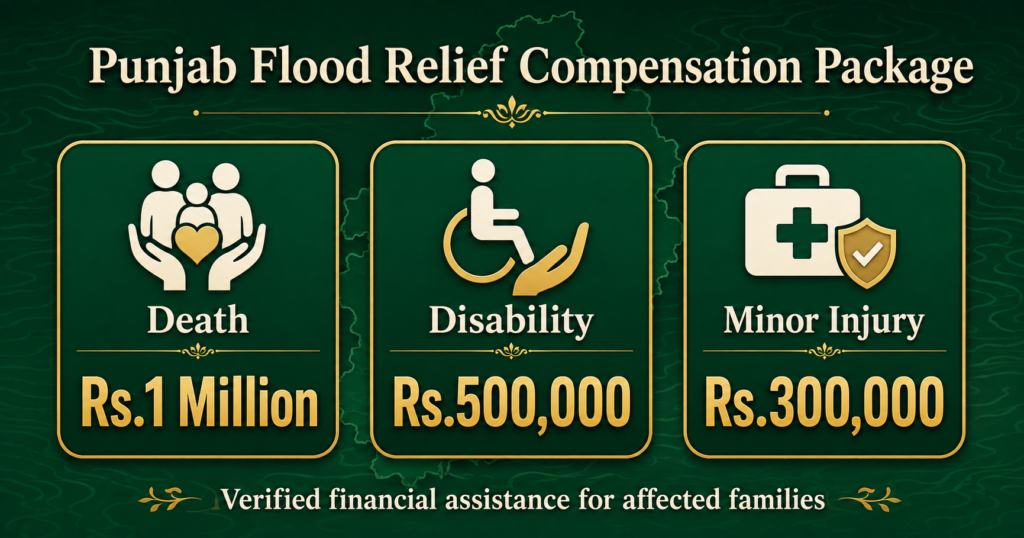
Compensation for Death and Injuries
Families that lost a loved one due to flooding may receive Rs.1 million. The announced assistance categories are:
| Type of loss | Compensation |
|---|---|
| Death of a family member | Rs.1,000,000 |
| Permanent disability | Rs.500,000 |
| Minor injury | Rs.300,000 |
The death must be connected to the flood or heavy-rain emergency and verified through the relevant medical, administrative and identity records.
The amount for permanent disability is Rs.500,000, while a person classified under the minor-injury category may receive Rs.300,000. The final classification depends on official verification rather than the applicant’s own description of the injury.
People needing broader medical support can also read our Punjab Health Connect Program 2026 guide to understand another Punjab healthcare initiative.
Compensation for Damaged Concrete Houses
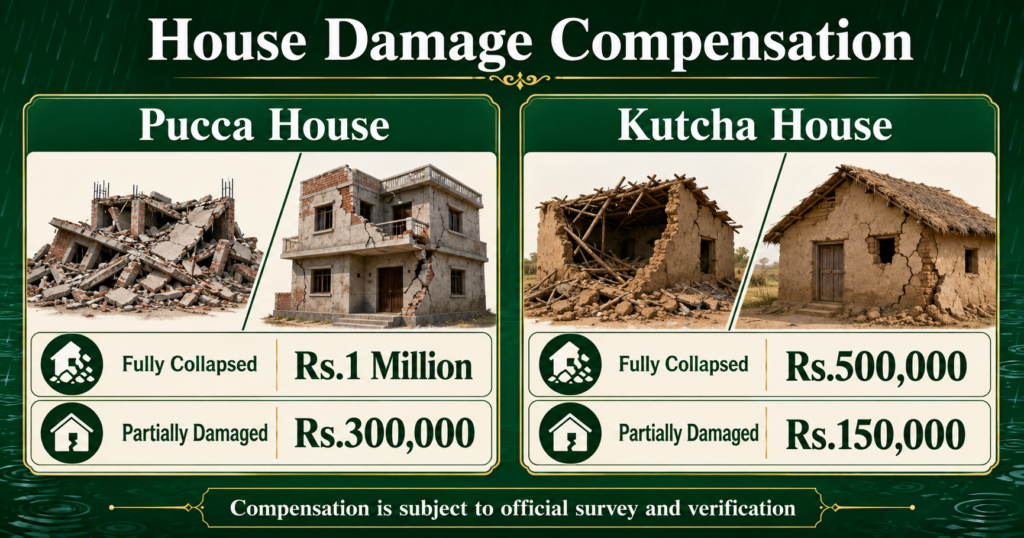
The programme distinguishes between fully collapsed and partially damaged concrete houses. These are commonly called pucca houses.
| Condition of concrete house | Compensation |
|---|---|
| Completely collapsed | Rs.1,000,000 |
| Partially damaged | Rs.300,000 |
A fully collapsed concrete house may qualify for Rs.1 million. If the structure remains standing but has suffered verified partial damage, the announced compensation is Rs.300,000.
Surveyors may inspect walls, roofs, foundations and the overall safety of the structure. Therefore, residents should not remove all visible evidence of damage before the survey unless the structure creates an immediate safety risk.
Compensation for Damaged Mud Houses
Mud or kutcha houses have separate compensation rates:
| Condition of mud house | Compensation |
|---|---|
| Completely collapsed | Rs.500,000 |
| Partially damaged | Rs.150,000 |
An eligible family with a completely collapsed mud house may receive Rs.500,000. Compensation of Rs.150,000 is provided for a verified partially damaged mud structure.
This flood-damaged house compensation can help families begin reconstruction, purchase building materials or arrange safer temporary accommodation. Families temporarily without shelter may also read about the Ehsaas Panahgah programme and check whether any suitable shelter facility is operating nearby.
Livestock Loss Compensation
Livestock represents an important source of income for many rural households. Losing a cow, buffalo, goat or sheep can leave a family without milk, food or daily earnings.
| Livestock category | Compensation |
|---|---|
| Large livestock | Up to Rs.500,000 |
| Small animals | Rs.50,000 |
The Punjab livestock loss compensation provides assistance of up to Rs.500,000 for large livestock and Rs.50,000 for small animals, subject to official assessment.
Survey teams may record the animal type, number of animals lost, ownership information and circumstances of the loss. Applicants should provide truthful details because duplicate or inaccurate claims can be rejected during verification.
Rural women interested in long-term livelihood assistance can also see the Livestock Asset Transfer to Rural Women Scheme.
What About Crop and Livelihood Losses?
The programme overview refers to people who lost crops and sources of income. However, the published compensation summary clearly lists specific rates only for death, disability, injury, house damage and livestock loss.
It is therefore better not to assume a crop-compensation amount that has not been officially stated on the programme page. Farmers should contact the local Agriculture Department, revenue office or district administration to confirm whether a separate crop damage compensation survey applies in their district.
Who May Qualify for Flood Assistance?
A complete public eligibility checklist is not provided with the programme summary. Based on the programme’s stated purpose, assistance is intended for residents of officially affected Punjab areas whose losses were recorded and verified by government teams.
Potential beneficiaries may include:
- Families of people who died during the floods
- People who sustained verified injuries
- Victims left with a permanent disability
- Owners or residents of collapsed concrete houses
- Families living in damaged mud houses
- Livestock owners whose animals died in the disaster
- Other affected households included in an authorised survey
Living in a flood-affected district alone may not guarantee payment. The household and its loss normally need to be recorded, verified and approved.
How to Register for the Punjab Sailab Bahali Program
The Wazir-e-Aala Punjab Sailab Bahali Program registration process is survey-based. The official information does not advertise an open self-registration portal where everyone can directly apply.
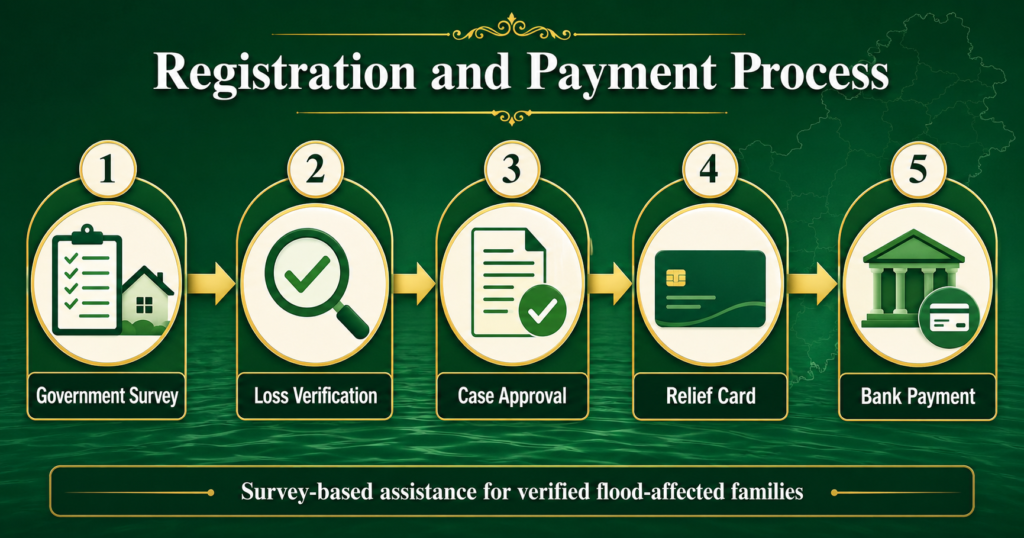
Step 1: Survey and Data Collection
Government teams visit flood-hit villages, towns and neighbourhoods. They collect information about affected families, damaged houses, deaths, injuries and livestock losses.
Residents should provide accurate identity, family and property information. If the survey team has not visited an affected location, residents should contact the district administration, Assistant Commissioner’s office or local PDMA representative.
Step 2: Inspection and Verification
The reported losses are checked by the responsible departments. Verification may involve physical inspection, identity confirmation, land or property records, medical documents and local administrative reports.
The purpose of this stage is to ensure that compensation reaches genuine victims and that the amount matches the verified category of loss.
Step 3: Approval of Assistance
Once the information has been checked, eligible cases are approved. An incomplete record, incorrect CNIC, duplicate claim or unverified loss may delay the decision.
Step 4: Issuance of Relief Card
Approved families receive a Punjab Flood Relief Card linked to their bank account. The card is intended to provide secure and direct access to compensation without involving private agents.
Step 5: Payment Through Bank of Punjab
The approved amount is disbursed through the designated banking arrangement. Beneficiaries should follow the instructions received from the government or Bank of Punjab and keep their CNIC and Relief Card secure.
Documents and Information to Keep Ready
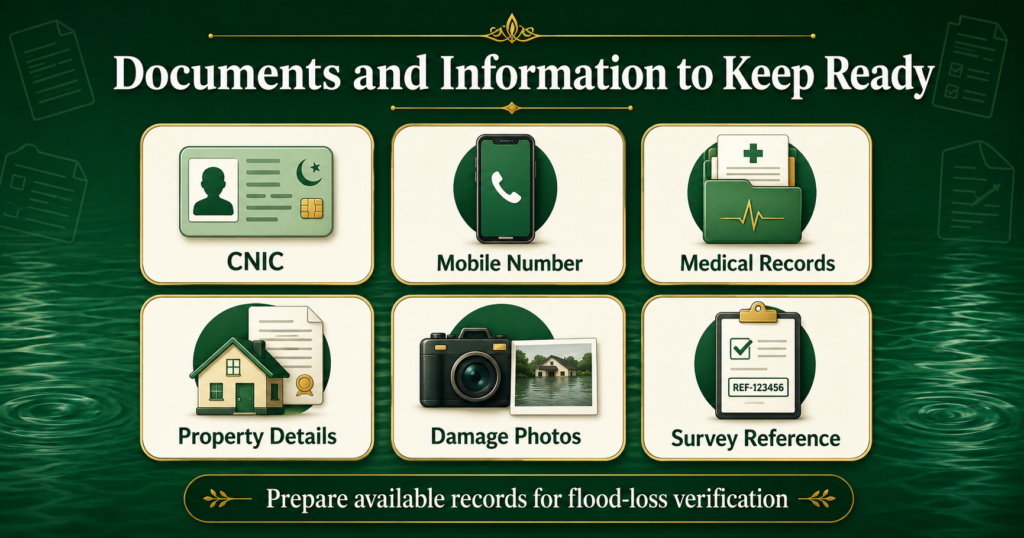
The exact requirements may vary by claim, but affected families should prepare:
- Original CNIC and a copy
- Active mobile number registered in the beneficiary’s name
- Residential address and district details
- Family information
- Death certificate, where applicable
- Hospital or medical records for injuries
- Disability assessment or medical certificate
- Proof of residence, ownership or occupancy
- Photographs or videos of house damage
- Land or property documents, if available
- Livestock ownership or veterinary information
- Survey slip, reference number or verification message
Missing a document does not necessarily mean that a genuinely affected person cannot be surveyed. The local administration should explain which alternative record may be accepted.
How to Check Survey or Payment Status
No universal CNIC-checking portal or SMS code is stated on the official programme page. Beneficiaries should avoid entering their CNIC on unofficial websites claiming to provide a Sailab Bahali Program online check.
For reliable information, contact:
- District Administration office
- Deputy Commissioner or Assistant Commissioner office
- Local PDMA representative
- Bank of Punjab, after card approval
- The survey team assigned to the affected area
- Government of Punjab’s official programme page
People who need help communicating an unresolved public-service issue can also review Maryam Ko Batayn 2026 and confirm whether helpline 1000 handles their particular complaint.
Departments Working on the Programme
The rehabilitation process involves several organisations:
- PDMA Punjab: Disaster response and coordination
- PITB: Digital systems and data support
- Bank of Punjab: Relief Card and payment services
- Urban Unit: Survey and planning support
- PLRA: Verification of relevant land records
- NADRA: Identity verification
- Agriculture Department: Assessment related to agricultural losses
- District Administrations: Local surveys, verification and implementation
This multi-department approach allows identity records, property information and local survey findings to be checked before money is released.
Important Fraud-Prevention Advice
Beneficiaries should never pay an agent for inclusion in the survey. Government compensation should not require a bribe, processing fee or commission.
Do not share a bank PIN, ATM password, verification code or complete card details with anyone. Official surveyors may require identity information, but they do not need your secret banking credentials.
Avoid links sent through unknown WhatsApp numbers. Use only official Punjab government pages and instructions received from verified district officials. For comparison, families looking for food assistance can read our Ehsaas Rashan Program guide while remaining careful about fake registration agents.

Frequently Asked Questions
Final Words
The Wazir-e-Aala Punjab Sailab Bahali Program 2025 offers substantial support to families recovering from serious flood losses. Its survey-based system, departmental verification and bank-linked Relief Cards are intended to deliver assistance securely and transparently.
Affected families should preserve evidence of their losses, provide accurate information during the survey and follow up with their district administration if their home was missed. Most importantly, beneficiaries should rely only on official channels and never pay an agent for flood compensation.
For confirmed programme information and future notices, consult the official Government of Punjab flood-relief page.