
Punjab Air Ambulance Service 2026: Complete Guide
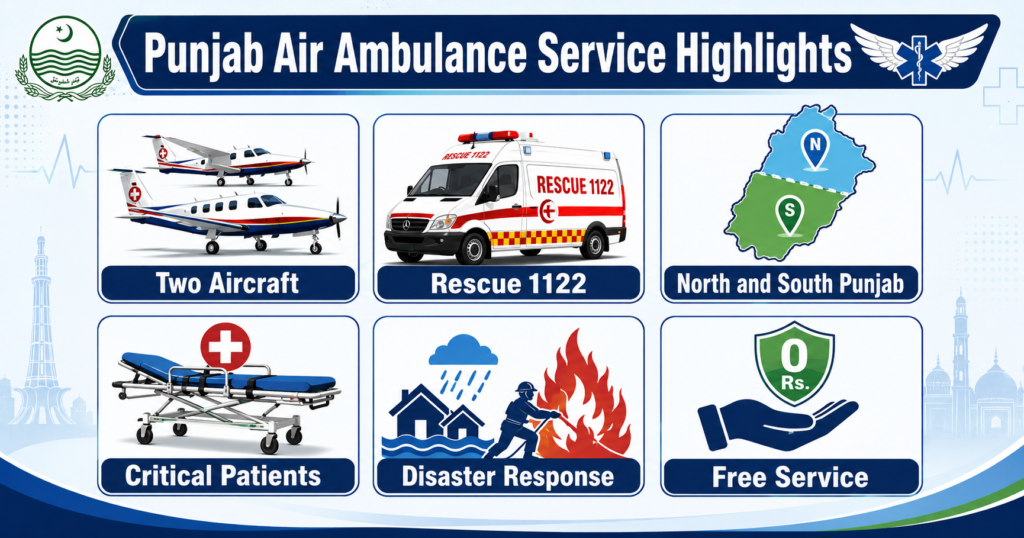
The Punjab Air Ambulance Service is a major emergency healthcare initiative launched by the Punjab government under the leadership of Chief Minister Maryam Nawaz Sharif. It has been established to transport critically ill or seriously injured patients from distant areas of North and South Punjab to hospitals where specialised treatment is available.
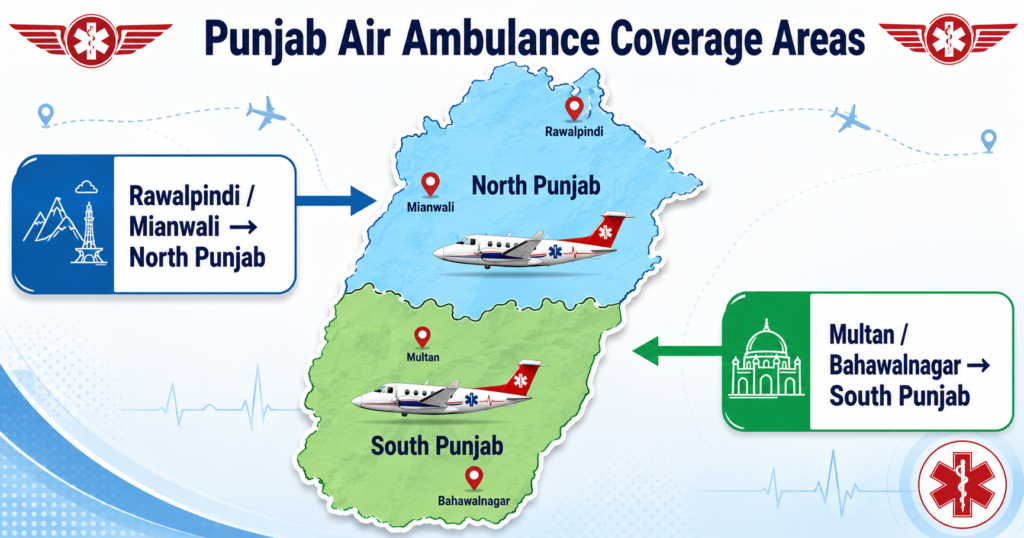
The service is managed through the Punjab Emergency Service, commonly known as Rescue 1122. Two air ambulances were initially deployed to provide coverage across the province. One operates around Rawalpindi and Mianwali, while the other covers the Multan and Bahawalnagar side.
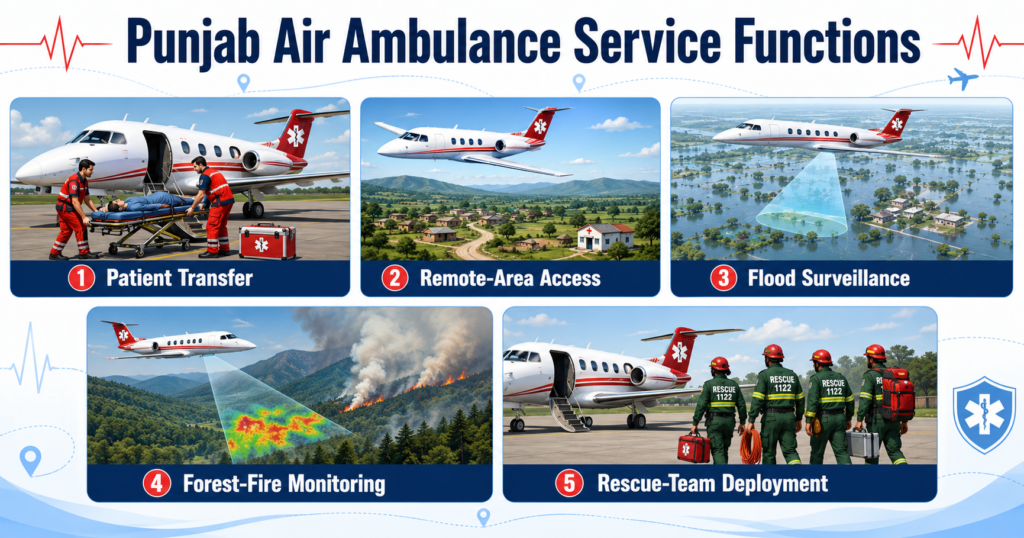
Apart from transporting patients, the aircraft can support aerial surveillance during floods and forest fires and help deploy rescue teams during major disasters. This makes the project more than a patient transportation service; it is also an important part of Punjab’s wider emergency and disaster-response system.
Punjab Air Ambulance Service Overview
| Programme feature | Details |
|---|---|
| Programme name | Punjab Air Ambulance Service |
| Introduced by | Government of Punjab |
| Launched under | Chief Minister Maryam Nawaz Sharif |
| Managing department | Punjab Emergency Service Rescue 1122 |
| Number of air ambulances | Two |
| Northern station | Rawalpindi or Mianwali |
| Southern station | Multan or Bahawalnagar |
| Main purpose | Transfer of critical patients |
| Additional functions | Flood surveillance, forest-fire monitoring and disaster response |
| Emergency number | 1122 |
| Public online application | No separate registration portal announced |
| Patient charges | Free for officially approved cases |
What Is the Punjab Air Ambulance Service?
The programme is an official medical evacuation service in Punjab designed for patients who cannot receive the required treatment at their nearest hospital. It allows Rescue 1122 to transfer selected patients to major healthcare institutions in cities such as Lahore, Rawalpindi and Multan.
For example, a patient suffering from a severe spinal injury, heart emergency, stroke or major accident may need a specialist who is unavailable at the district level. Travelling for several hours by road can be dangerous, especially when the patient is unstable. An air ambulance can reduce travel time and help the patient reach an appropriate hospital sooner.
The CM Punjab Air Ambulance Service is not a regular passenger flight or privately bookable aircraft. Its use depends on the patient’s medical condition, a doctor’s recommendation, hospital coordination, aircraft availability, weather and flight-safety conditions.
Why Was the Service Launched?
Punjab has many remote and underserved communities located far from tertiary-care hospitals. Although local hospitals can provide initial emergency treatment, they may not have advanced facilities such as neurosurgery, cardiac intervention, specialised intensive care or major trauma treatment.
The Maryam Nawaz Air Ambulance Service was developed to address this gap. Its primary goals include:
- Providing access to far-flung areas
- Transferring critical patients without unnecessary delay
- Connecting district hospitals with specialised medical centres
- Improving emergency services in North and South Punjab
- Conducting aerial surveillance during floods
- Monitoring forest fires from the air
- Deploying trained rescue teams during disasters
The service is closely associated with the idea of the Golden Hour emergency service. The golden hour is the early period following a serious injury or medical crisis during which rapid medical treatment can significantly affect a patient’s chances of survival and recovery.
How Many Air Ambulances Are Working?
According to the Punjab government’s programme information, two aircraft were deployed for the initiative. One was designated for Rawalpindi or Mianwali to cover northern districts, while the second was positioned around Multan or Bahawalnagar for southern Punjab.
An official programme page previously stated that the two aircraft had transferred 124 patients. However, this represents an older programme snapshot. Figures presented in the Punjab Assembly in April 2026 reported that 254 critically ill patients had been transported. More recent government promotional material has referred to over 300 successful transfers.
Therefore, the number of beneficiaries should be treated as a changing operational figure rather than a fixed total.
Reports published in April 2026 identified the two operational aircraft as a Cessna 206 and a Piper Seneca. Rescue 1122 provides medical personnel and equipment, while aviation arrangements are handled under a contracted operational model.
Who Can Use the Air Ambulance?
There is no permanent beneficiary list like those used for financial-assistance programmes. Air ambulance eligibility is primarily determined by medical urgency.
A patient may be considered if:
- The patient is critically ill or seriously injured.
- Specialised treatment is unavailable at the current hospital.
- A qualified doctor recommends urgent transfer.
- Travelling by road may take too long or worsen the condition.
- The receiving hospital has agreed to accept the patient.
- The patient is stable enough for air transportation.
- An appropriate airstrip is accessible.
- Weather and visibility conditions are safe.
- Rescue 1122 approves the mission after assessment.
An air ambulance is normally reserved for severe and time-sensitive situations. A family’s request alone does not guarantee approval. Medical professionals and Rescue 1122 officials must determine whether flying is necessary and safer than using a ground ambulance.
Medical Conditions That May Be Considered
The service may assist selected patients experiencing:
- Severe road-accident injuries
- Head or spinal trauma
- Serious burns
- Heart attacks or cardiac emergencies
- Stroke or sudden paralysis
- Critical pregnancy complications
- Life-threatening childhood illnesses
- Organ failure requiring advanced care
- Serious injuries caused by disasters
- Other conditions requiring urgent specialist treatment
These examples do not form an automatic eligibility list. Every case is evaluated individually according to the patient’s condition and available medical options.
Readers searching for other government healthcare initiatives can visit the [Punjab Health Connect Program 2026: Free Treatment Guide]. That programme focuses on specialist treatment and knowledge transfer, whereas the air ambulance primarily provides critical patient transportation.
Is the Punjab Air Ambulance Service Free?
The Punjab government describes the initiative as a free air ambulance in Punjab for patients whose cases are approved through the official emergency system. Eligible families are not expected to pay for the aircraft’s flight or government rescue arrangements.
There is no application fee, registration agent or paid form for requesting the service. Anyone demanding money in exchange for approval should be treated with suspicion.
The government covers the operational expenses, but this does not mean that an aircraft is available for every medical transfer. The patient must meet the medical and operational requirements determined by Rescue 1122.
How to Request an Air Ambulance
There is currently no separate website where families can complete Punjab Air Ambulance online registration. The service is accessed through Rescue 1122 and official hospital-referral channels.
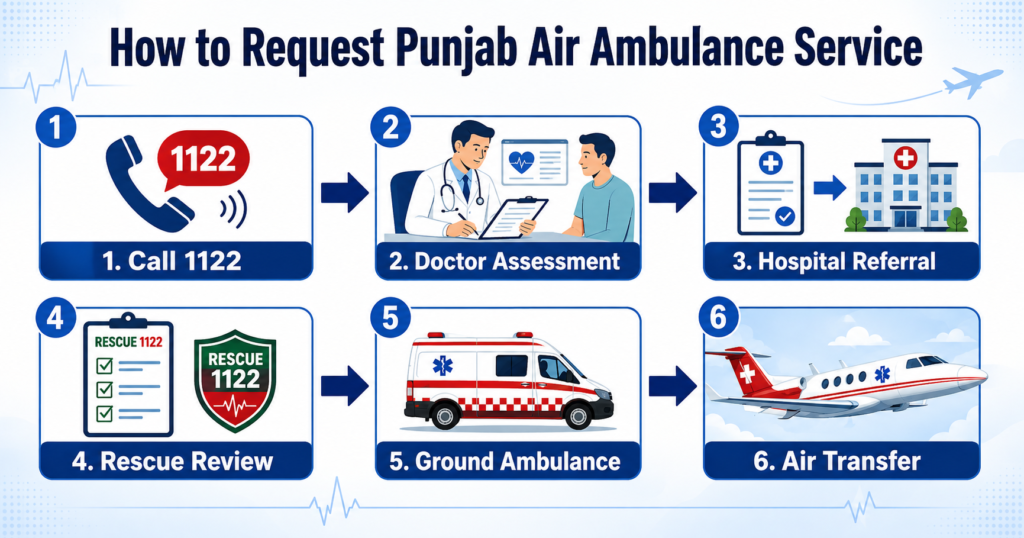
Step 1: Call Rescue 1122
Dial 1122 and explain the emergency. Give the operator the patient’s location, condition, current hospital and a working contact number.
Step 2: Get the Patient Examined
The patient should be assessed by a qualified doctor. The doctor will determine whether treatment is available locally or whether the patient needs to be transferred.
Step 3: Obtain a Referral
If specialised care is required, the treating doctor or hospital administration may prepare a referral or transfer recommendation.
Step 4: Confirm a Receiving Hospital
Before the flight, officials generally need to identify a hospital with the required specialist, equipment and available bed.
Step 5: Rescue 1122 Assessment
The Rescue 1122 Air Ambulance team assesses medical urgency, distance, aircraft availability, runway access, patient stability and weather conditions.
Step 6: Stabilisation and Ground Transportation
The patient is stabilised before the journey. A ground ambulance may transfer the patient from the current hospital to a nearby airstrip.
Step 7: Air Transfer
The patient is flown to the selected destination with appropriate medical support.
Step 8: Transfer to the Receiving Hospital
After landing, another ground ambulance takes the patient from the airstrip to the specialised hospital.
Information and Documents to Keep Ready
Although there is no standard public application form, keeping important information ready can help officials assess the case quickly.
Families may need:
- Patient’s CNIC or B-Form
- CNIC of the responsible attendant
- Recent medical reports
- Doctor’s referral or transfer recommendation
- Diagnosis and treatment history
- Current hospital’s details
- Receiving hospital’s details
- Contact information for the treating doctor
- Information about oxygen or monitoring requirements
- Working phone numbers of family members
Families should not delay first aid while collecting paperwork. During a genuine emergency, call 1122 immediately and follow the operator’s instructions.
Role of Rescue 1122
The Punjab Rescue 1122 service is responsible for coordinating emergency response, medical assessment, ground transportation and communication with relevant departments.
Rescue 1122 also operates ambulance, fire, water-rescue, motorbike-rescue and specialised disaster-response services. Adding aircraft to this system allows the department to support emergencies that cannot be handled efficiently through road transportation alone.
Role During Floods and Other Disasters
The project is not limited to transferring hospital patients. The aircraft can also strengthen Punjab’s response to natural disasters.
Its disaster-related functions include:
Aerial Surveillance of Floods
Aircraft can observe flood-affected districts, identify isolated communities and help officials understand the scale of damage.
Forest-Fire Monitoring
Aerial observation can help locate fire-affected areas and guide ground teams toward places that require immediate intervention.
Deployment of Rescue Teams
Trained personnel and essential equipment may be sent to distant locations when roads are blocked or normal access is difficult.
Medical Evacuation
Injured or critically ill people can potentially be moved from disaster-affected areas to safer locations or suitable hospitals.
People affected by flooding can also read the [Wazir-e-Aala Punjab Sailab Bahali Program] guide for information about rehabilitation and recovery assistance.
Medical Facilities During the Flight
An air ambulance is configured to provide medical support while the patient is being transported. Available equipment may vary depending on the aircraft and the patient’s needs.
Typical arrangements may include:
- A secure patient stretcher
- Medical oxygen
- Vital-sign monitoring
- Emergency medicines
- Basic resuscitation equipment
- Communication systems
- Trained medical or Rescue 1122 personnel
An aircraft is not a complete hospital. Therefore, the patient must be medically assessed and stabilised before departure whenever possible. Doctors also consider whether the patient can safely tolerate changes associated with flight.
Benefits of the Programme
The service can provide several important benefits:
- Faster transportation over long distances
- Improved access to specialist hospitals
- Better emergency support for remote districts
- Medical monitoring during transfer
- Reduced dependence on lengthy road journeys
- Stronger coordination between hospitals
- Faster deployment during disasters
- Improved surveillance of floods and forest fires
It can be especially valuable in Mianwali, Bahawalnagar and other districts where travelling to a specialised hospital may otherwise take several hours.
Limitations Families Should Understand
Air transportation is not possible in every case. The aircraft may be unavailable or unable to fly because of:
- Fog, rain, storms or poor visibility
- An unsuitable or unavailable runway
- Aircraft maintenance
- Flight-safety restrictions
- Patient instability
- Lack of space at the receiving hospital
- A ground ambulance being medically more suitable
- Multiple emergencies occurring simultaneously
Fixed-wing aircraft need a usable landing strip. They cannot normally land directly outside a patient’s home or hospital. Ground ambulances are therefore still required at both ends of the journey.
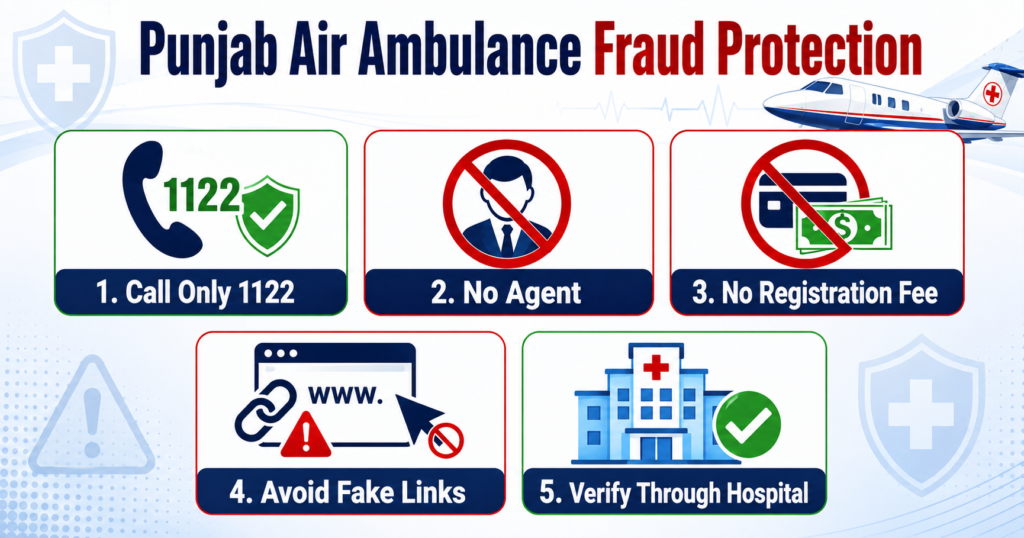
Avoid Fake Registration and Agents
Families facing a medical emergency can easily become targets of fraud. Follow these precautions:
- Contact Rescue 1122 by dialing 1122.
- Never pay an agent for an aircraft transfer.
- Avoid unofficial online registration forms.
- Do not share banking PINs or verification codes.
- Confirm instructions with the hospital administration.
- Use Punjab government and Rescue 1122 sources.
- Keep copies of medical records and referrals.
For non-emergency complaints or requests for provincial assistance, readers may consult [Maryam Ko Batayn 2026: Call 1000 for Free Help]. However, the Maryam Ko Batayn helpline is not a substitute for Rescue 1122 during a medical emergency.
Low-income households looking for food assistance can also read the [Ehsaas Rashan Program]. Families researching historical emergency financial assistance may visit the [Ehsaas Emergency Cash Program: Rs 12,000 Complete Guide]. These are separate welfare programmes and do not determine air ambulance approval.
Punjab Air Ambulance Contact Number
The official air ambulance contact number is the Rescue 1122 emergency helpline:
Dial 1122
When speaking to the operator, provide:
- The patient’s exact location
- The patient’s current condition
- The name of the current hospital
- The treating doctor’s recommendation
- The required medical speciality
- The proposed receiving hospital, if known
- A reliable contact number
Callers should remain calm, answer questions accurately and follow all medical instructions.
Frequently Asked Questions
Conclusion
The Punjab Air Ambulance Service is an important development in Punjab’s emergency healthcare system. It helps connect remote districts with specialised hospitals while also supporting flood monitoring, forest-fire surveillance and rescue-team deployment.
Two aircraft provide coverage for North and South Punjab through operational locations around Rawalpindi, Mianwali, Multan and Bahawalnagar. However, this is a medically controlled emergency service rather than an ordinary booking programme.
Families should call 1122, obtain a doctor’s assessment and keep medical information ready. They should never pay an agent or use an unofficial registration link. When approved and safely available, the programme can reduce transportation delays and give critical patients faster access to life-saving treatment.