Ehsaas Disabled Person Program 2026 Registration Guide
The Ehsaas Disabled Person Program is commonly searched by people looking for government financial assistance for persons with disabilities in Pakistan. Although many websites continue to use this name, applicants should understand that disability information and household eligibility are generally processed through NADRA, the Benazir Income Support Programme, the National Socio-Economic Registry, and other government welfare departments.
A person does not automatically receive cash simply because they have a disability. The applicant’s disability must be recorded correctly, the household must complete the required survey, and the relevant department must verify eligibility. Payment amounts and selection rules can also change according to the active government scheme and available budget.
This guide explains Ehsaas disabled person registration, eligibility, documents, the NSER survey, 8171 status checking, NADRA verification and alternative assistance available through Pakistan Bait-ul-Mal.
Important update: Do not assume that every registered person will receive Rs.2,000 per month. This amount is frequently mentioned on older websites, but applicants should confirm the current payment from BISP, 8171 or the relevant welfare department.
What Is the Ehsaas Disabled Person Program?
The term refers to social-protection support intended for poor and vulnerable households that include a person with a disability. The purpose is to reduce financial hardship and help eligible families cover necessities such as food, healthcare, transportation and assistive equipment.
Applicants may be considered for BISP financial assistance, provincial disability schemes, Pakistan Bait-ul-Mal assistance or other welfare benefits. However, these are separate schemes and may have different application forms, eligibility requirements and payment schedules.
The earlier Ehsaas initiative and the current BISP system should not be treated as two completely identical programs. Ehsaas was a wider social-protection framework, while BISP is an established cash-transfer institution operating under its own law and eligibility system.
Families facing a sudden financial emergency may also read our Ehsaas Emergency Cash Program guide to understand how emergency assistance programs operate.
Key Features of Disability Assistance
The assistance available to a deserving person may include:
- Cash assistance for an eligible low-income household
- Registration of disability information in the NSER database
- Financial support through Pakistan Bait-ul-Mal
- Wheelchairs, hearing aids or artificial limbs
- Medical-treatment assistance
- Educational assistance for eligible students
- Access to provincial welfare programs
- Payment through an officially designated bank or payment centre
Benefits are not identical for every applicant. The department may consider the household’s income, poverty score, property, employment, family structure and disability status before approving assistance.
Who Can Apply in 2026?
A person may apply or update their household information if they:
- Are a Pakistani citizen with a valid CNIC or B-Form
- Have a disability recognized by the relevant authority
- Have disability information recorded with NADRA
- Belong to a low-income or financially vulnerable household
- Have completed or updated the NSER dynamic survey
- Meet the conditions of the specific assistance scheme
- Provide authentic documents during verification
Having a disability certificate does not guarantee approval for BISP cash assistance. BISP eligibility is normally assessed at the household level. This means the complete financial and social condition of the family may be considered.
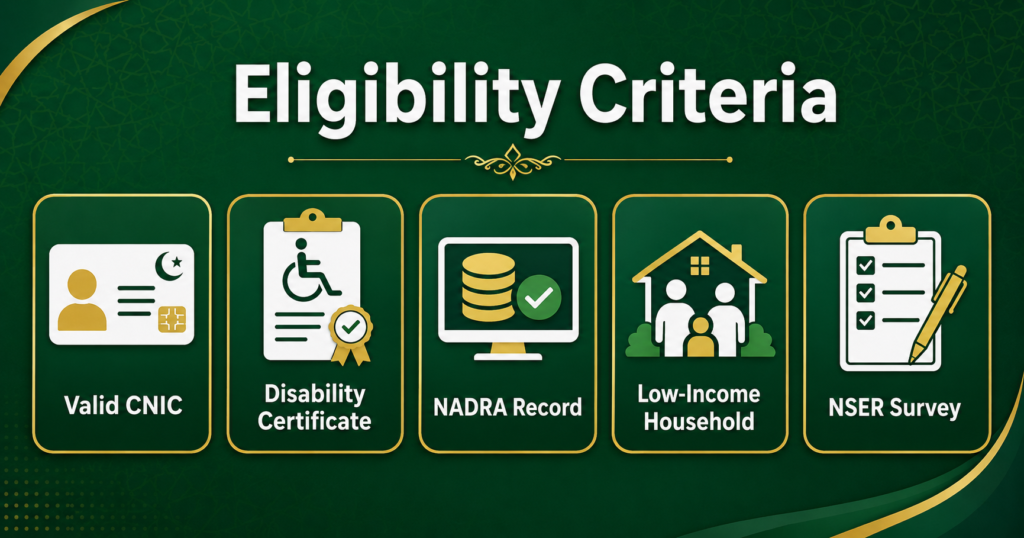
Ehsaas Disabled Person Program Eligibility Criteria
The following conditions may affect eligibility:
Valid Identification
An adult applicant should have a valid CNIC. A child may require a B-Form or Juvenile Card. The document should contain accurate personal and family information.
Verified Disability Record
The applicant may need a disability assessment or certificate from the authorized provincial department or medical assessment board. Their NADRA record should also show the correct disability status.
NADRA states that the first identity document for a person with a disability is issued free of charge and may display the universal disability logo. Applicants can review NADRA’s inclusive registration information.
Low Household Income
Assistance is primarily intended for deserving families. The department may examine income, employment, assets, utility consumption and other socioeconomic indicators.
NSER Registration
The National Socio-Economic Registry stores information used to evaluate households for social-protection programs. If disability, address, marital status or household composition has changed, the family should update its dynamic survey.
Successful Verification
Approval may require verification through NADRA, BISP, biometric records and the relevant welfare department. Incorrect or incomplete information can delay the decision.
Documents Required for Registration
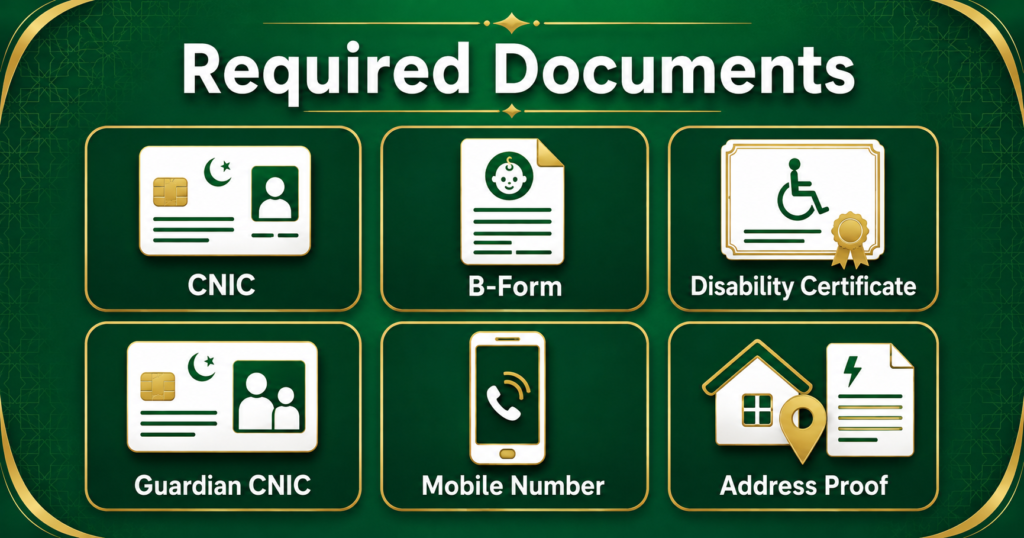
Keep the following documents ready before visiting a registration centre:
- Original CNIC of the person with a disability
- CNIC of the household head, parent or guardian
- B-Form for an applicant under 18
- Valid disability certificate
- Special person CNIC, where available
- Recent passport-size photographs
- Registered mobile number
- Household electricity or gas bill
- Income or employment information
- Medical reports, if requested
- Proof of address
- Death certificate of a parent or spouse, where relevant
Take original documents as well as photocopies. The officer may need to inspect the originals before accepting the application.
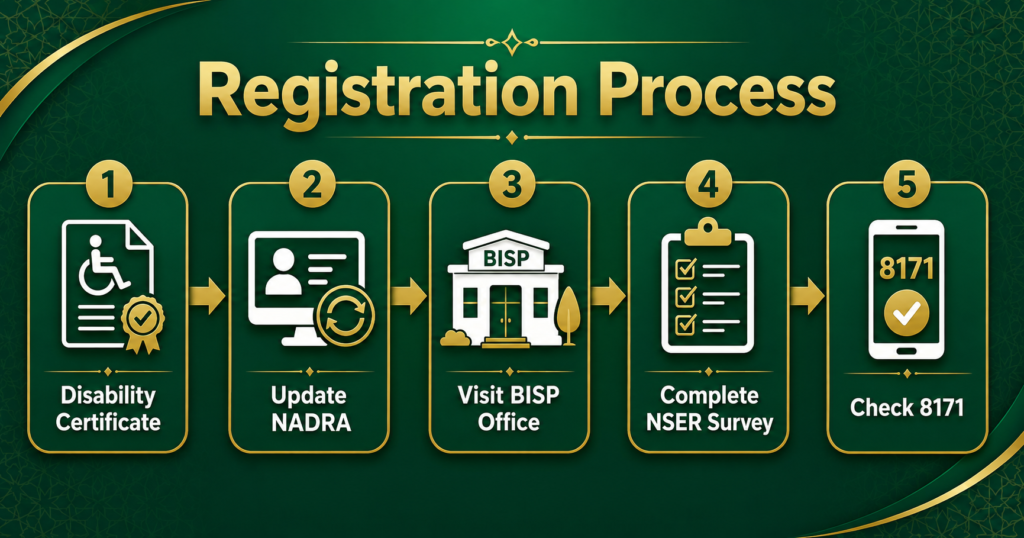
How to Register for the Ehsaas Disabled Person Program
There is no reason to pay an agent for BISP registration for disabled persons. Follow these official steps instead.
Step 1: Obtain a Disability Certificate
Visit the relevant Social Welfare Department, disability assessment board or designated government hospital in your province. The applicant may be medically assessed before a disability certificate is issued.
The exact procedure varies by province, so confirm the required hospital, board and documents from your district’s Social Welfare Office.
Step 2: Update the NADRA Record
Visit a NADRA Registration Centre and ask for the disability status to be added or corrected. Take the disability certificate and other identity documents with you.
Check the applicant’s name, date of birth, address, marital status and family record carefully. A mismatch between the CNIC, disability certificate and household information may create problems during verification.
Step 3: Complete the NSER Dynamic Survey
Visit the nearest BISP Tehsil Office or authorized NSER registration centre. Provide information about every household member, including education, employment, disability, income, housing and assets.
BISP has explained that the Dynamic Registry can record changes in household and disability information using NADRA data. Registration in the survey is free.
Step 4: Provide a Mobile Number
Give a mobile number that is regularly used by the applicant or an immediate family member. Do not provide an agent’s number. Official notifications and verification messages may be sent to the registered number.
Step 5: Complete Biometric Verification
If the household is declared eligible, the beneficiary may be required to complete biometric verification before receiving payment.
Persons whose fingerprints cannot be verified should report the problem to the BISP office instead of repeatedly paying unauthorized retailers.
Step 6: Check the Application Status
Use the official 8171 service or visit a BISP Tehsil Office to check the result. Selection may not happen immediately after the survey because the information must first be verified.
How to Check Eligibility Through 8171
The 8171 disability check generally follows the same official status-checking process used for BISP applicants.
Enter the applicant’s CNIC on the official 8171 portal when it is available, or send the CNIC number without dashes to 8171. Follow only the instructions received from the official number.
If the response says that a dynamic survey is required, visit the BISP Tehsil Office. If the record is under verification, wait for the official decision. If the household is declared ineligible, ask the office whether its information can be updated or whether a review is available.
Never trust a message from an ordinary mobile number claiming that your payment has been approved.
Payment Amount and Collection Method
Older online articles often claim that every eligible person receives Rs.2,000 each month. Applicants should not publish or rely upon this amount as a confirmed 2026 rate unless an official notification supports it.
The payment amount depends on the scheme under which the person is approved. A beneficiary may receive household assistance through BISP, annual support through Pakistan Bait-ul-Mal or benefits under a provincial program.
If a payment is approved:
- Wait for an official notification.
- Visit the authorized payment point.
- Carry the original CNIC.
- Complete biometric verification.
- Count the full amount before leaving.
- Obtain a receipt whenever available.
- Report an illegal deduction immediately.
Do not hand over your CNIC or payment card to an unauthorized agent.
Registration Through Pakistan Bait-ul-Mal
Pakistan Bait-ul-Mal operates assistance programs for persons with disabilities, also described as “Special Friends.” Depending on eligibility and available resources, support may include financial aid, wheelchairs, artificial limbs or hearing aids.
Applicants can download the relevant form from the official Pakistan Bait-ul-Mal assistance page. Complete the form, attach the required documents and submit it to a district, regional or provincial PBM office.
The PBM application is separate from the BISP dynamic survey. Completing one application does not automatically register the applicant for every other welfare program.
People seeking treatment-related assistance can also explore the CM Dialysis Program and learn about emergency patient transportation through the Punjab Air Ambulance Service.
Common Reasons for Rejection or Delay
An application may be delayed or rejected because:
- Disability is not recorded in the NADRA database
- The disability certificate is missing or invalid
- The CNIC has expired
- Household information is incomplete
- The NSER survey has not been updated
- Income or asset information exceeds the scheme’s limit
- Family records contain conflicting details
- Biometric verification is unsuccessful
- The mobile number is incorrect
- The scheme’s quota or budget is limited
Correcting information does not guarantee approval, but it helps ensure that the household is assessed using accurate records.
Assistance for Education, Skills and Employment
Financial assistance should be combined with education and employment opportunities wherever possible. Students with disabilities should ask their institution about fee concessions, disability quotas, scholarships and accessible facilities.
University students can review the Ehsaas Scholarship for Students for general guidance on need-based educational support.
Young graduates interested in technology may also check the KPITB Internship Program 2026. Applicants planning to establish a business in Punjab can learn about digital registrations through eBiz Punjab.
Eligibility under these programs is separate, so applicants must read the conditions of each opportunity.
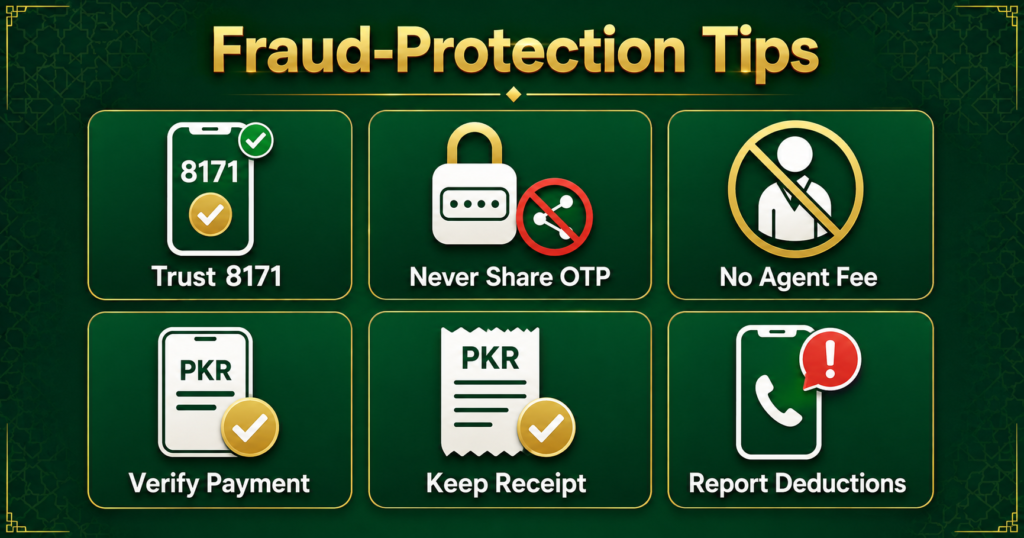
Fraud-Protection Tips
Registration and the NSER survey are free. Protect yourself by following these precautions:
- Trust messages only from 8171
- Never share an OTP or PIN
- Do not pay an agent for registration
- Never give anyone your original CNIC permanently
- Use only official government websites
- Do not click suspicious payment links
- Keep the survey receipt or token safely
- Report illegal deductions to BISP
- Verify every payment announcement before travelling
Frequently Asked Questions
Final Words
The Ehsaas Disabled Person Program can be understood as a pathway to government welfare assistance rather than a single guaranteed monthly payment for every person with a disability. The safest process is to obtain a valid disability certificate, update the NADRA record, complete the NSER dynamic survey and check the result through 8171.
Applicants should use only official offices and government communication channels. Accurate documents and updated household information can make verification easier, but final approval always depends on the rules and assessment of the relevant program.